
Crítica em português
Incapaz de aprofundar a mitologia do próprio universo, Dolly elege a maternidade como pano de fundo de um terror slasher genérico com boneca assassina.
A obsessão do cinema de terror pela figura de bonecas não é de hoje. Do brinquedo assassino Chucky no cinema norte-americano, símbolo do final da década de 1980, ao boneco assustador do giallo italiano Prelúdio Para Matar, o horror do século XXI igualmente já se viu marcado pela presença desses objetos, em formato de maldição e possessão, como no caso de Annabelle (da franquia Invocação do Mal e seus spin-offs), na forma de se debater sobre o uso de inteligência artificial, como a boneca-robô M3GAN; ou mesmo como algo assombroso à sua própria forma, como é o caso de Brahms em O Boneco do Mal. Tanto já se trabalhou dentro da referida temática que o presente Dolly surge como um claro indício de esgotamento do tema dentro do cinema hollywoodiano.
Adaptado do curta Babygirl, lançado em 2023 como forma de atrair interesse para sua versão em longa-metragem (e por isso leia-se, o presente filme, Dolly), o cineasta Rod Blackhurst pouco consegue aproveitar das ideias apresentadas anteriormente, ao construir um longa de oitenta minutos com quase nenhuma novidade.
Se em um primeiro momento o diretor sugeriu um projeto com traços experimentais, voltados ao ponto de vista de uma vítima em meio a uma situação desesperadora de sequestro em uma floresta, Dolly, na verdade, propõe uma espécie de revisita as bases do terror slasher, nos Estados Unidos da década de 1970, com influências diretas que remetem ao clássico de Tobe Hopper O Massacre da Serra Elétrica. A filmagem em 16mm, e um filtro riscado colocado posteriormente por cima da imagem, emula a ausência de recursos do projeto homenageado, em uma tentativa de dele se aproximar através do apelo estético.
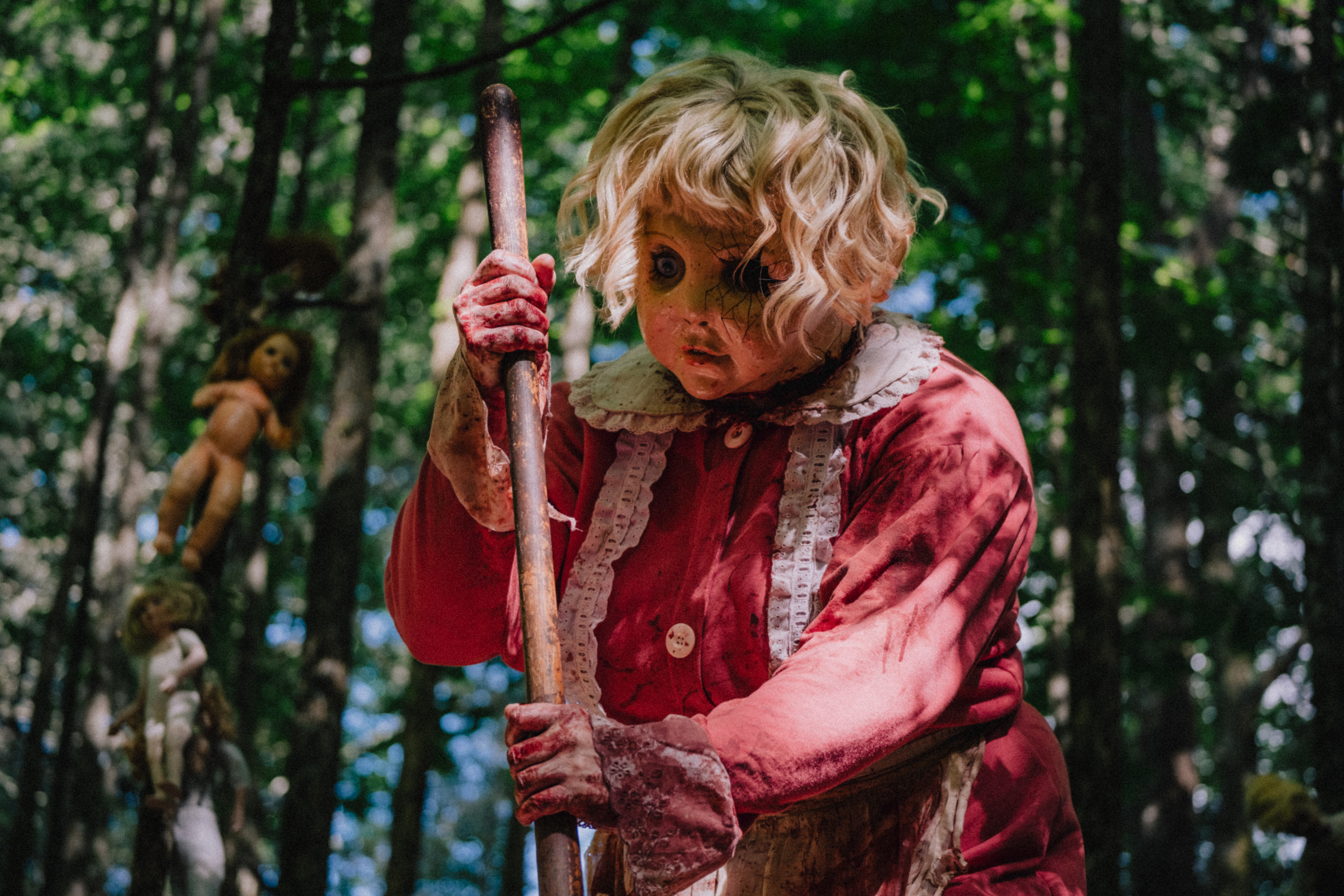
A narrativa, de princípio, também não se afasta de uma premissa básica do subgênero, porquanto voltada a um casal, Macy e Chase (vividos por Fabianne Therese e Seann William Scott), que, em uma trilha na floresta, se depara com uma misteriosa assassina, vestindo uma máscara de porcelana em forma de boneca (vivida por Max the Impaler). Com a captura de Macy, no entanto, descobre-se que seu interesse não é exatamente matar, mas sim transformar a protagonista em uma “boneca-viva”, aprisionando-a em uma casa que parece
de brinquedo, num jogo doentio.
Em que pese a boneca servir como força motriz do terror na obra, o tema da maternidade assume o protagonismo temático, ao menos superficialmente. Porquanto Macy revela, nos instantes iniciais, em conversa com uma amiga, através de uma chamada de vídeo pelo celular, seu desinteresse em ter filhos, manifestando-se como um medo reprimido de tornar-se uma pessoa tal qual a própria mãe, a antagonista busca ter filhos através de linhas tortas – leia-se, sequestrando pessoas para tratá-las como bebês. O embate estabelecido, dessa forma, deveria tornar-se um verdadeiro duelo entre as personagens, se o roteiro assinado por Blackhurst e Brandon Weavil tivesse alguma noção sobre onde efetivamente gostaria de chegar com isso.
Na superfície, até existe a ideia de enfrentamento do medo de ser mãe por parte da protagonista, e da dependência emocional da vilã, mas ambas nunca são efetivamente exploradas no decorrer da narrativa. Apesar da situação provocativa arquitetada, e do embate que articula, o decorrer da obra se resume, basicamente, a uma luta por sobrevivência de Macy contra a “boneca gigante”. Aos poucos, a maternidade é esquecida em troca de um corre-corre, perseguições e tentativas de tornar a protagonista uma bebê.
Em algumas oportunidades, Blackhurst até obtêm êxito na forma como encena essas passagens grotescas – os melhores momentos do filme – quando o terror abandona a forma genérica para apostar no verdadeiro incômodo (a cena do leite materno é assustadora). Mas além de escassos, esses instantes de inspiração normalmente culminam em mais perseguições desinteressantes, em cuja câmera do diretor parece nunca saber o que deseja efetivamente filmar. Mexendo-se a todo tempo, e muitas vezes exageradamente próxima do rosto dos atores, a decupagem, tentando emular desespero por meio de planos claustrofóbicos e sugerindo certo amadorismo, para combinar com a estética setentista e o filtro riscado, acaba por ser, ao fim, amadora de fato, e não de maneira elegante, como intenta.
A câmera subjetiva, que domina o curta, sendo seu elemento mais interessante, ao retratar o olhar da vítima, é abandonada em Dolly para apostar em algo formalmente mais tradicional. Ainda que exista alguma tentativa da direção em apoiar-se no formalismo, por meio de momentos que pendem ao surrealismo e a construção de uma simbologia apta a talvez justificar os atos da vilã – como o estranho porão, por exemplo –, nada se desenvolve de verdade, ao ponto de fazer algum sentido ao espectador. Todas as vezes que busca desenrolar uma ideia, e explorar da própria mitologia, tão logo desiste e volta seu olhar para outros lugares, deixando tudo, ao final, incompleto.
Dessa maneira, Dolly coloca sobre a mesa uma série de ideias ao longo de seus quase oitenta minutos de duração, mas, sem um direcionamento para onde deseja seguir, ou o que pretende debater, apenas as condensa de qualquer maneira em um terror slasher genérico, sempre ameaçando construir uma simbologia que nunca se ergue de fato. Mais um exemplo disso, inclusive, é a divisão em capítulos, com diferentes títulos (como pai, mãe, filha, casa), que apenas servem, na prática, para quebrar e esvaziar o ritmo intenso, em segmentos específicos a fim de, a cada dez minutos, reconstruir a tensão. E ainda que tentasse trabalhar temas como maternidade e dependência emocional, o filme apenas os utiliza como um raso pano de fundo para justificar violência e um desenrolar óbvio, mostrando-se incapaz de fazer diferente do que tantos outros em décadas, se alimentando de inspirações sem trazer quaisquer refrescos ao gênero.
Dolly estreia nos cinemas dos Estados Unidos e do Reino Unido no dia 6 de março. No Brasil, a estreia está marcada para o dia 14 de maio.
As inscrições para o Clube do Crítico 37, com o tema Cinema & Jornalismo, estão abertas. O início das aulas é 7 e 9 de março. Saiba mais.
English review
Unable to explore the mythology of its own universe, Dolly chooses motherhood as the backdrop for a generic slasher horror film centered on a killer doll.
The obsession of horror cinema with dolls is nothing new. From the murderous toy Chucky in north-american cinema, a symbol of the late 1980s, to the strange doll in the Italian giallo Deep Red, 21st-century horror has also been marked by the presence of these objects – whether through curses and possession, as in Annabelle (from The Conjuring franchise and its spin-offs), through debates about artificial intelligence, as with the robot doll M3GAN, or as something uncanny in its own right, as with Brahms in The Boy. So much has already been done within this theme that Dolly emerges as a clear sign of the subject’s exhaustion within Hollywood cinema.
Adapted from the short film Babygirl, released in 2023 as a way to attract interest in its feature-length version (that is, the present film, Dolly), filmmaker Rod Blackhurst manages to extract very little from the ideas previously presented, constructing an eighty-minute feature with almost nothing new to offer.
If at first the director seemed to suggest a project with experimental traits – centered on the point of view of a victim in a desperate kidnapping situation in a forest – Dolly actually proposes a kind of return to the foundations of north-american 1970s slasher horror, with direct influences that point to Tobe Hooper’s classic The Texas Chainsaw Massacre. The 16mm shooting format, along with a scratched filter later applied over the image, emulates the lack of resources of the referenced film, attempting to approach it through aesthetic appeal.
The narrative also initially adheres to a basic premise of the subgenre, focusing on a couple, Macy and Chase (played by Fabianne Therese and Seann William Scott), who, while hiking in the forest, encounter a mysterious killer wearing a porcelain doll mask (played by Max the Impaler). With Macy’s capture, however, it becomes clear that the antagonist’s interest is not exactly in killing, but in transforming the protagonist into a “living doll,” imprisoning her in a house that resembles a toy home, in a sick game.
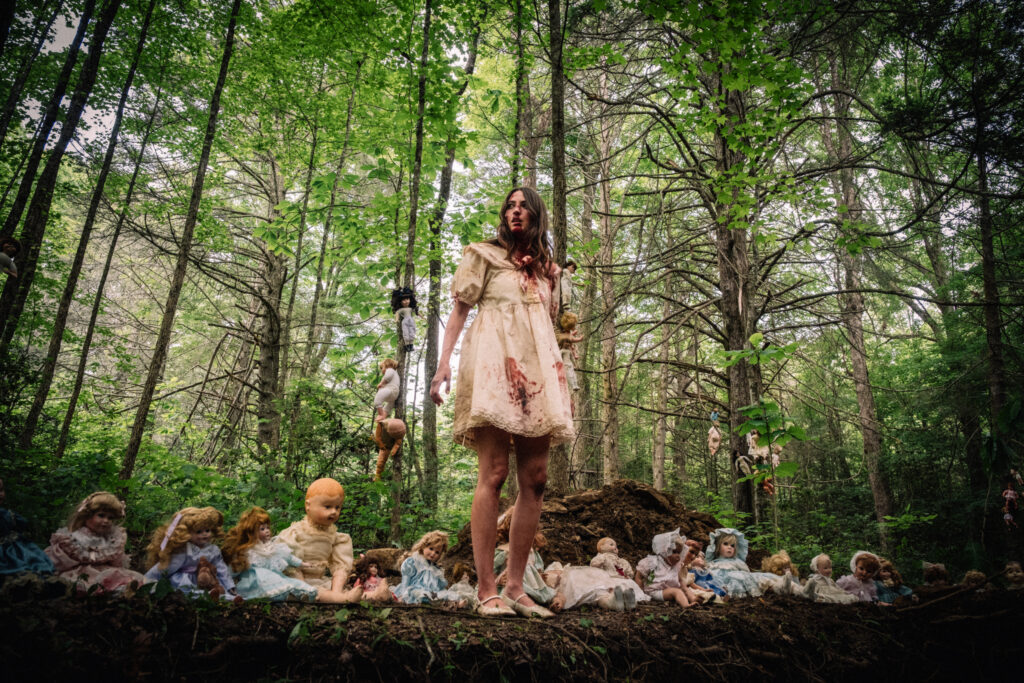
Although the doll serves as the driving force of the film’s horror, the theme of motherhood assumes thematic protagonism – at least superficially. Early on, in a video call with a friend, Macy reveals no interest in having children, expressing a repressed fear of becoming like her own mother. The antagonist, in turn, seeks to have children through twisted means – that is, by kidnapping people and treating them as babies. The conflict established between them should, therefore, become a true duel between the two characters, if the screenplay by Blackhurst and Brandon Weavil had any real sense of where it wanted to go with this idea.
On the surface, there is indeed the notion of the protagonist confronting her fear of motherhood and the villain’s emotional dependency, but neither is truly explored throughout the narrative. Despite the provocative situation and the conflict it sets up, the film ultimately reduces itself to a survival struggle between Macy and the “giant doll.” Gradually, motherhood is forgotten in favor of chases, pursuits, and repeated attempts to turn the protagonist into a baby.
At times, Blackhurst does succeed in the way he stages these grotesque moments – the film’s best scenes – when the horror abandons generic form and embraces genuine discomfort (the breast milk scene is disturbing). But these moments of inspiration are scarce and usually culminate in more uninteresting chases, in which the director’s camera never seems to know what it actually wants to film. Constantly moving, and often excessively close to the actors’ faces, the découpage, trying to emulate desperation through claustrophobic
framing, suggest a certain amateurism to match the 1970s aesthetic and scratched filter, and ends up being amateurish in fact, and not in an elegant or deliberate way.
The subjective camera, which dominates the short film and is its most interesting element, by embodying the victim’s gaze, is abandoned in Dolly in favor of a more traditionally formal approach. Although there are attempts by the direction to lean on formalism, through moments that verge on surrealism and the construction of a symbolism that might justify the villain’s actions – such as the strange basement, for example – nothing is truly developed to the point of making sense to the viewer. Every time the film tries to unfold an idea or explore its own mythology, it quickly gives up and shifts its focus elsewhere, leaving everything incomplete in the end.
Thus, Dolly places a series of ideas on the table throughout its nearly eighty-minute runtime, but without any clear direction about where it wants to go or what it intends to discuss. It simply condenses them into a generic slasher horror film, constantly threatening to build a symbolism that never actually materializes. Another example of this is the division into chapters, with different titles (such as father, mother, daughter, house), which in practice only serve to break and empty the film’s intense rhythm, segmenting it so that every ten minutes tension can be artificially rebuilt. And even though it attempts to engage with themes such as motherhood and emotional dependency, the film uses them merely as a shallow backdrop to justify violence and an obvious narrative progression, proving incapable of doing anything different from so many others over the decades -feeding on inspirations without bringing any real freshness to the genre.
Dolly opens in theaters in the United States and the United Kingdom on March 6.

Crítico de cinema desde 2019. Formado em crítica de cinema pela Academia Internacional de Cinema (2020), e aluno do Clube do Crítico desde 2021, é criador do Cineolhar e colaborador do Cinema com Crítica.