

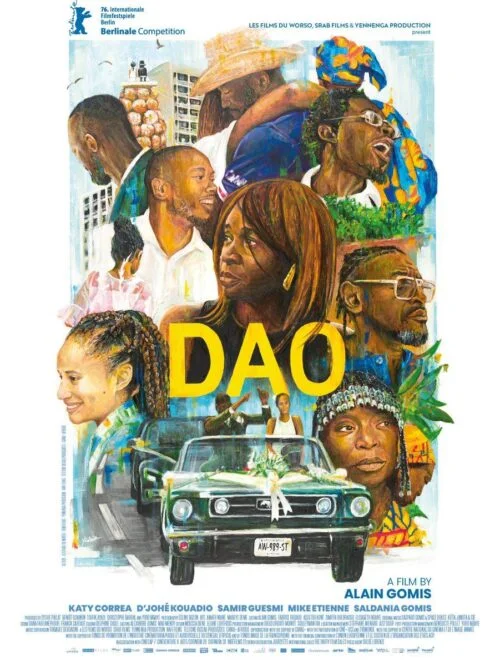
“DAO é o movimento perpétuo e circular que flui em tudo e une o mundo.” Ao iniciar Dao aproximando o espectador do título-conceito que permeia seu filme, Alain Gomis antecipa uma ideia de mobilidade contínua de energia, moldando nossa experiência de modo a buscar esse fluxo. Essa é, sem grandes mistérios, a parte que percebemos. O que não notamos, porém, é como, inconscientemente, deixamos de procurar para nos integrarmos a esse movimento quase imperceptivelmente. Aquilo que é circular, perpétuo e fluido torna-se matéria e ritmo fílmicos — somos introduzidos pela explicação, instigados pela curiosidade e quase hipnotizados por sua cadência ritualística.
É justamente nos rituais que Dao, que disputou o Urso de Ouro na Competição da 76ª Berlinale, encontra a forma de dar vazão ao seu conceito e colocar em prática esse impulso cíclico. O primeiro deles a se revelar é o próprio ritual de fazer cinema. Gomis brinca com os limites e os liames entre o documental e o ficcional ao nos inserir em um estúdio onde mulheres negras se reúnem para serem entrevistadas pelo diretor. A linguagem adotada é a do tradicional documentário de cabeças falantes, e o tema desse diálogo é assumidamente metalinguístico. Ele conta que está realizando um filme — uma ficção — e pergunta: “que papel você quer fazer?”
Com naturalidade, entre reflexões sobre liberdade criativa, inventividade, improviso e ajustes repentinos de câmera, essas mulheres, atrizes e não atrizes, passam a revelar os personagens que desejam interpretar: mulheres submissas, mulheres que matam os maridos, mulheres que prometem a vida a seus amados. Querem ser mães e filhas. Alain Gomis nos convida a participar do casting de Dao e do processo de escolha daquilo que decidiu-se que será contado: a história de uma família e sua cultura. Sob a premissa de que só é possível narrar aquilo que já se conhece, o trânsito para a ficção se materializa na protagonista Gloria (Katy Correa) e sua filha Nour (D’Johé Kouadio), prestes a se casar, que retornam ao lugar de onde vieram seus ancestrais para reencontrar suas raízes e, pouco a pouco, transformar essa jornada individual em uma experiência coletiva de realizações e reflexões pessoais.
O modo como o diretor trabalha a hibridez de Dao e aborda atores e não atores como partícipes e opinantes do processo fílmico, brincando com o gênero a ponto de não sabermos distinguir o que é ficção e o que é documentário — se é que há, ali, documentário de fato — remete muito ao estilo de filmar de Eduardo Coutinho. Tal como Coutinho, Gomis testa os limites de um cinema tematicamente regional, que dialoga com o espectador sobre o indivíduo e, por meio dele, constrói o retrato de um povo, de uma cultura, de um espaço-tempo.
Se para o diretor brasileiro, sobretudo em Jogo de Cena, a palavra constitui a matéria-prima primordial do cinema, e a metalinguagem se estabelece como seu próprio método de investigação dos corpos e vozes que se expressam – bem como de sua função como cineasta interventor, que depura o dispositivo de toda perfumaria para fazer cinema -, Gomis parte de um pressuposto semelhante, ainda que em direção metalinguística distinta. Ele nos faz conhecer seu processo, mas sua viagem (esse movimento perpétuo) será imagética, emocional e sensorial.
Os demais rituais que impulsionam Dao são culturais, representados pela ficcionalização de dois acontecimentos ordinários, mas de grande relevância: um casamento e um funeral. Assim como a fluidez circular que une o mundo, e como um blues que, progressivo e improvisado, alcança seu ápice para então recomeçar, essas duas cerimônias fazem parte do trânsito da vida, reunindo famílias em momentos de emoções e sentimentos muito distintos, mas que igualmente marcam ritos de passagem. O casamento acontece em Paris, o funeral, na Guiné-Bissau. Quem se casa é Nour; quem falece é seu avô, patriarca do vilarejo para o qual ela retorna ao lado da mãe.
Na cultura ali representada, ambas as solenidades são motivo de celebração e parecem dilatar o tempo: duram dias, ou ao menos é essa a sensação que temos. O ritmo das festas nos envolve de maneira tão atraente que não é difícil sentir que somos – ou gostaríamos de ser – parte daquela família imensa, tão afetuosa quanto conflituosa. Há toques e carinhos, abraços e beijos, conversas maduras e brigas imaturas, lágrimas e sorrisos. Há muita música, e a trilha sonora não diegética, quase monotemática (o mesmo tema reaparece em diferentes ocasiões) funciona justamente porque essa repetição também carrega o sentido circular de Dao.
Elementos específicos da cultura africana marcam, igualmente, o sentido compassado da obra: a importância da escuta dos mais velhos, da honra, da oralidade, da espiritualidade e dos sacrifícios é mobilizada por Gomis para conferir uma dimensão de coletividade ao filme e fazer com que seu significado ultrapasse o âmbito familiar, tornando-o representativo de um povo e da maneira como deseja ser visto no cinema. Ademais, o retorno da protagonista às suas origens expressa momentos específicos da vida em que a busca pela ancestralidade se impõe com mais força, além de carregar a relevância de lançar luz sobre antepassados estrategicamente apagados pela história da colonização.
É preciso saber de onde se vem para que seja possível voltar. Esse saber ancestral, transmitido, num diálogo, pela anciã do vilarejo à protagonista Gloria, é síntese do significado circular de filmar tradições e rituais, e carrega em si, também, a metalinguagem proposta no início. Em Dao, contemplamos pessoas que, por sua vez, contemplam suas próprias origens, e o fazem através da participação do processo fílmico. Entre o casamento e o funeral, as festas parecem não acabar – e isso, no melhor dos sentidos – porque carregam uma energia vital que conecta gerações, como a própria fluidez do movimento que une o mundo. Amar, casar, celebrar, morrer e seguir: nesse ciclo, o cinema de Gomis encontra um modo de filmar pessoas, sentimentos e cultura concomitantemente, transformando o íntimo em memória coletiva e perpetuando-os em cinema.
English Version:
“DAO is the perpetual and circular movement that flows through everything and unites the world.” By beginning Dao by bringing the viewer closer to the title-concept that permeates his film, Alain Gomis anticipates an idea of continuous mobility of energy, shaping our experience so as to seek this flow. This is, without great mysteries, the part we perceive. What we do not notice, however, is how, unconsciously, we stop searching in order to integrate ourselves into this movement almost imperceptibly. That which is circular, perpetual, and fluid becomes filmic matter and rhythm — we are introduced through the explanation, instigated by curiosity, and almost hypnotized by its ritualistic cadence.
It is precisely in rituals that Dao, which competed for the Golden Bear in the Competition of the 76th Berlinale, finds the form to give outlet to its concept and put into practice this cyclical impulse. The first of them to reveal itself is the very ritual of making cinema. Gomis plays with the limits and the links between the documentary and the fictional by inserting us into a studio where Black women gather to be interviewed by the director. The language adopted is that of the traditional talking-head documentary, and the theme of this dialogue is admittedly metalinguistic. He says that he is making a film — a fiction — and asks: “what role do you want to play?”
With naturalness, among reflections on creative freedom, inventiveness, improvisation, and sudden camera adjustments, these women, actresses and non-actresses, begin to reveal the characters they wish to interpret: submissive women, women who kill their husbands, women who promise their lives to their loved ones. They want to be mothers and daughters. Alain Gomis invites us to participate in the casting of Dao and in the process of choosing what it was decided will be told: the story of a family and its culture. Under the premise that it is only possible to narrate what is already known, the transition to fiction materializes in the protagonist Gloria (Katy Correa) and her daughter Nour (D’Johé Kouadio), about to get married, who return to the place from which their ancestors came in order to reconnect with their roots and, little by little, transform this individual journey into a collective experience of personal achievements and reflections.
The way the director works with the hybridity of Dao and approaches actors and non-actors as participants and opinion-givers in the filmic process, playing with the genre to the point that we cannot distinguish what is fiction and what is documentary — if there is, there, documentary at all — greatly recalls the style of filming of Eduardo Coutinho. Like Coutinho, Gomis tests the limits of a thematically regional cinema, which dialogues with the viewer about the individual and, through him, constructs the portrait of a people, of a culture, of a space-time.
If for the Brazilian director, especially in Jogo de Cena, the word constitutes the primordial raw material of cinema, and metalanguage establishes itself as his own method of investigation of the bodies and voices that express themselves — as well as of his function as an interventionist filmmaker, who purifies the device of all perfumery in order to make cinema — Gomis departs from a similar assumption, although toward a distinct metalinguistic direction. He makes us know his process, but his journey (this perpetual movement) will be imagetic, emotional, and sensory.
The other rituals that drive Dao are cultural, represented by the fictionalization of two ordinary events, but of great relevance: a wedding and a funeral. Just like the circular fluidity that unites the world, and like a blues that, progressive and improvised, reaches its apex only to begin again, these two ceremonies are part of the transit of life, gathering families in moments of very distinct emotions and feelings, but which equally mark rites of passage. The wedding takes place in Paris; the funeral, in Guinea-Bissau. The one who marries is Nour; the one who dies is her grandfather, patriarch of the village to which she returns alongside her mother.
In the culture represented there, both solemnities are reasons for celebration and seem to dilate time: they last days, or at least that is the sensation we have. The rhythm of the festivities involves us in such an attractive way that it is not difficult to feel that we are — or would like to be — part of that immense family, as affectionate as it is conflictive. There are touches and caresses, hugs and kisses, mature conversations and immature quarrels, tears and smiles. There is a lot of music, and the non-diegetic soundtrack, almost monothematic (the same theme reappears on different occasions), works precisely because this repetition also carries the circular meaning of Dao.
Specific elements of African culture also mark the measured sense of the work: the importance of listening to the elders, of honor, of orality, of spirituality, and of sacrifices is mobilized by Gomis to give a dimension of collectivity to the film and make its meaning go beyond the family sphere, making it representative of a people and of the way it wishes to be seen in cinema. Moreover, the protagonist’s return to her origins expresses specific moments in life in which the search for ancestry imposes itself more strongly, in addition to carrying the relevance of shedding light on ancestors strategically erased by the history of colonization.
It is necessary to know where one comes from so that it is possible to return. This ancestral knowledge, transmitted in a dialogue by the elder woman of the village to the protagonist Gloria, synthesizes the circular meaning of filming traditions and rituals, and also carries within it the metalanguage proposed at the beginning. In Dao, we contemplate people who, in turn, contemplate their own origins, and do so through participation in the filmic process. Between the wedding and the funeral, the festivities seem never to end — and this, in the best sense — because they carry a vital energy that connects generations, like the very fluidity of the movement that unites the world. To love, to marry, to celebrate, to die and to continue: in this cycle, Gomis’s cinema finds a way of filming people, feelings, and culture simultaneously, transforming the intimate into collective memory and perpetuating them in cinema.


Crítica de cinema, formada pelo Talents Rio da Berlinale e Goethe Institut. Membra do júri da Latin American Critics Awards for European Films e da Comissão de Cinema da APCA (Associação Paulista de Críticos de Arte).