


Há personagens cuja própria presença em cena já expressa, em miniatura, o significado do filme que habitam. Em The Loneliest Man in Town, dirigido por Tizza Covi e Rainer Frimmel que disputou o Urso de Ouro na 76ª Berlinale, essa síntese se revela no gesto aparentemente banal em que seu protagonista posa pacientemente para fotografias. O cenário é composto por uma bela paisagem ao fundo – um lago e um bosque verde – diante da qual um homem idoso aparece vestido com uma camisa xadrez e uma pequena gravata de laço preto. Empunhando uma guitarra ressonadora apoiada nos braços, ele olha para o horizonte como se fosse uma peça em exposição. Aquele homem, que parece preso ao passado, acaba por se confundir com o próprio espaço. É um relicário vivo, um pequeno museu ambulante de hábitos, gestos, memórias e afetos que tentam resistir ao tempo.
The Loneliest Man in Town acompanha Alois Koch (Al Cook), um músico de blues registrado e imortalizado nos discos que marcaram seu auge, além de um homem solitário que nasceu e viveu toda a sua existência no mesmo edifício e no mesmo apartamento em Viena, capital austríaca. O prédio encontra-se vazio e condenado à demolição em razão da especulação e da pressão imobiliária que avançam sobre a região – Koch é o único e último morador que restou. Sua rotina é cercada por objetos que parecem condensar toda a sua vida: discos antigos (seus e de seus ídolos), fotografias, quadros e roupas que aparenta guardar há décadas, mas que permanecem impecáveis. Cada gesto seu, bem como o cuidado que dedica a esses objetos, revela um modo de viver quase ritualístico.
Cabe mencionar e esclarecer que Alois Koch e Al Cook são a mesma pessoa, e que ele interpreta a si próprio no longa dirigido por Tizza Covi e Rainer Frimmel. Al Cook é, de fato, uma personalidade real da música austríaca, inspirada por Elvis Presley, que alcançou certa notoriedade regional a partir da década de 1970. The Loneliest Man in Town, portanto, assume um caráter híbrido, na medida em que se aproxima do registro documental ao acompanhar a rotina desse homem diante de uma mudança forçada, e também mobiliza elementos de ficcionalização para elaborar o drama que o envolve.
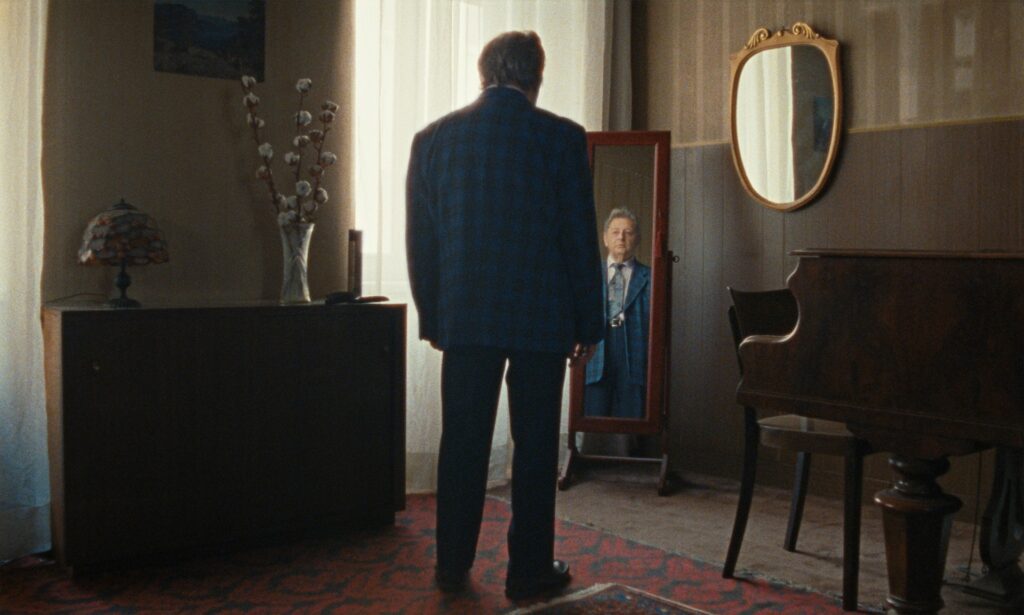
Há algo de muito melancólico, mas também respeitoso e afetuoso, na maneira como o filme observa esse homem que parece existir fora do tempo. Alois fala devagar, move-se com calma, veste ternos e gravatas de estampas florais que evocam outra época, e seu lar, que funciona essencialmente como um estúdio de gravação, lembra uma espécie de gruta, ou mesmo um brechó vintage, onde cada objeto carrega vestígios de um passado pulsante naquela presença.
Logo no início do longa, ele comemora o festejo natalino só: monta uma árvore iluminada por velas, abre uma garrafa de espumante e escuta blues atenciosamente, até que a energia elétrica subitamente se apaga. O apagão integra a pressão para que ele deixe o prédio e se mude dali. Quando tudo se apaga, restam as velas. Há um simbolismo evidente – o velho modo de viver representado pelo personagem que, no fim das contas, permanece ali, improvisando e dando conta daquilo que a modernidade já não é capaz de sustentar.
A relação entre personagem e espaço e o modo como ele precisa se adequar às demandas do mundo constituem o eixo dramático de The Loneliest Man in Town. O prédio que Alois insiste e resiste em habitar não é apenas um lugar físico, mas uma extensão de sua própria identidade. De fato, sua missão é reduzir toda uma vida àquilo que cabe numa maleta. Quando os representantes da empresa imobiliária surgem com ofertas para que ele deixe o apartamento, percebe-se que a disputa não se limita a uma negociação material: retirá-lo dali implica deslocar uma existência inteira.
Nesse ponto, The Loneliest Man in Town inevitavelmente faz remeter à Aquarius, de Kleber Mendonça Filho. Assim como Clara (Sonia Braga), Alois se torna a última figura resistente diante da lógica violenta da especulação imobiliária. Entretanto, enquanto o filme brasileiro constrói um embate entre indivíduo e mercado, aqui prevalece um caráter conformista, saudoso e agridoce, mas ainda assim sustentado pelo desejo de seguir adiante da forma que lhe é possível. Sua resistência se manifesta na continuidade dos pequenos rituais que estruturam sua vida, embora ele próprio compreenda que se tornou a parte vencida dessa relação.
O fato de ser encantador acompanhar a existência desse homem, que resiste movido pelo amor à música, por seu estilo de vida imutável e pela simplicidade ritualística de seus gestos, torna sua adaptação ainda mais nostálgica e melancólica, embora permaneça uma abertura para o futuro e para novas possibilidades de vida. Al Cook é uma figura adorável, resiliente justamente onde menos se espera, e para a qual o filme olha com evidente ternura. O fato de precisar esvaziar toda a sua vida não o impede de recomeçá-la, e a música – o blues, seu maior companheiro e aquele que o impulsionou durante toda a existência – segue cumprindo sua função. E há quem diga que ele é o homem mais solitário do mundo.
English Review:
There are characters whose mere presence on screen already expresses, in miniature, the meaning of the film they inhabit. In The Loneliest Man in Town, directed by Tizza Covi and Rainer Frimmel, which competed for the Golden Bear at the 76th Berlin International Film Festival, this synthesis is revealed in the apparently banal gesture in which its protagonist patiently poses for photographs. The setting is composed of a beautiful landscape in the background — a lake and a green forest — before which an elderly man appears dressed in a checkered shirt and a small black bow tie. Holding a resonator guitar in his arms, he looks toward the horizon as if he were a piece on display. That man, who seems trapped in the past, ends up blending with the very space around him. He is a living reliquary, a small walking museum of habits, gestures, memories, and affections that try to resist time.
The Loneliest Man in Town follows Alois Koch (Al Cook), a blues musician recorded and immortalized in the albums that marked his peak years, as well as a solitary man who was born and lived his entire life in the same building and in the same apartment in Vienna, the Austrian capital. The building is now empty and condemned to demolition due to the real estate speculation and pressure advancing over the region — Koch is the only and last resident who remains. His routine is surrounded by objects that seem to condense his entire life: old records (his own and those of his idols), photographs, paintings, and clothes that he appears to have kept for decades, yet which remain impeccable. Every gesture he makes, as well as the care he devotes to these objects, reveals a way of living that is almost ritualistic.
It should be mentioned and clarified that Alois Koch and Al Cook are the same person, and that he plays himself in the film directed by Tizza Covi and Rainer Frimmel. Al Cook is, in fact, a real personality of Austrian music, inspired by Elvis Presley, who achieved a certain regional notoriety starting in the 1970s. The Loneliest Man in Town, therefore, assumes a hybrid character, insofar as it approaches documentary register by following the routine of this man facing a forced change, while also mobilizing elements of fiction to elaborate the drama that surrounds him.
There is something deeply melancholic, but also respectful and affectionate, in the way the film observes this man who seems to exist outside of time. Alois speaks slowly, moves calmly, wears suits and ties with floral patterns that evoke another era, and his home — which essentially functions as a recording studio — resembles a sort of cave, or even a vintage thrift shop, where each object carries traces of a past that still pulses within that presence.
Early in the film, he celebrates Christmas alone: he sets up a Christmas tree illuminated by candles, opens a bottle of sparkling wine, and listens attentively to blues music, until the electricity suddenly goes out. The blackout is part of the pressure for him to leave the building and move away. When everything goes dark, only the candles remain. There is an evident symbolism here — the old way of living represented by the character which, in the end, remains there, improvising and coping with what modernity is no longer capable of sustaining.
The relationship between character and space, and the way he must adapt to the demands of the world, constitutes the dramatic axis of The Loneliest Man in Town. The building that Alois insists on inhabiting and resisting leaving is not merely a physical place, but an extension of his own identity. In fact, his task becomes reducing an entire life to what can fit inside a suitcase. When representatives of the real estate company appear with offers for him to leave the apartment, it becomes clear that the dispute does not limit itself to a material negotiation: removing him from there would also mean displacing an entire existence.
At this point, The Loneliest Man in Town inevitably recalls Aquarius, by Kleber Mendonça Filho. Just like Clara (Sônia Braga), Alois becomes the last resistant figure in the face of the violent logic of real estate speculation. However, while the Brazilian film constructs a confrontation between individual and market, here a conformist, nostalgic, and bittersweet character prevails, yet still sustained by the desire to move forward in whatever way remains possible. His resistance manifests itself in the continuity of the small rituals that structure his life, even though he himself understands that he has become the defeated side of this relationship.
The fact that it is charming to watch the existence of this man, who resists moved by his love of music, by his unchanging way of life, and by the ritualistic simplicity of his gestures, makes his adaptation even more nostalgic and melancholic, although there remains an openness toward the future and toward new possibilities of life. Al Cook is an endearing figure, resilient precisely where one least expects it, and one toward whom the film looks with evident tenderness. The fact that he must empty out his entire life does not prevent him from beginning it again, and music — the blues, his greatest companion and what propelled him throughout his existence — continues to fulfill its role. And there are those who say that he is the loneliest man in the world.


Crítica de cinema, formada pelo Talents Rio da Berlinale e Goethe Institut. Membra do júri da Latin American Critics Awards for European Films e da Comissão de Cinema da APCA (Associação Paulista de Críticos de Arte).