

Crítica em português
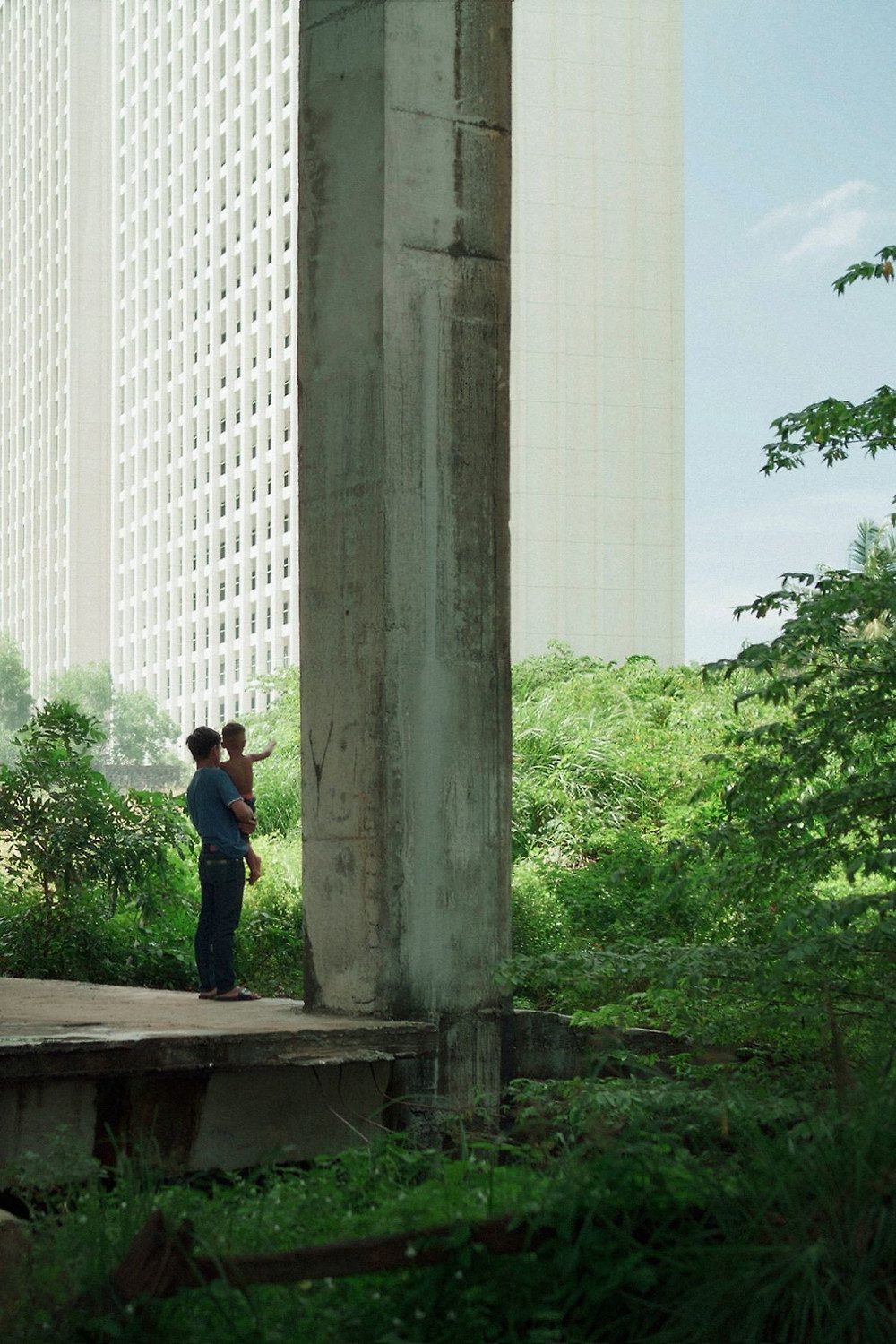
Há, logo na cena inicial de Promised Spaces, uma síntese que apresenta o espaço onde a ação acontecerá – o entorno de um condomínio habitacional que alia urbanidade e natureza – e o eixo moral e político que atravessa a obra do sérvio Ivan Marković. Ali, os arranha-céus ou os seus esqueletos, que preenchem o horizonte e simbolizam o avanço de uma modernização voraz e excludente. Acolá, o interior de um dormitório coletivo onde trabalhadores comprimidos em beliches disputam ar, silêncio e tentam dormir. O drama narrativo – se for possível assim chamá-lo – é o contraste entre quem constrói, a classe trabalhadora, e quem habita.
Esse início é continuado com a imagem de meia dúzia de varais carregados de roupas, prestes a serem arruinadas pela chuva súbita que cai, e exibe uma narrativa interessada em pensar esse cenário construído onde era uma vila de pescadores para além da mera locação. O que está em jogo, afinal, é a arquitetura e o urbanismo invisíveis de um sistema econômico neoliberal que redistribui os corpos, segundo uma lógica desumana e degradante. Neste aspecto, Sokun é mais metonímia da classe trabalhadora do que indivíduo propriamente dito. Com insônia, Sokun perambula pela escuridão da vizinhança do bairro, refletindo ao lado de outros trabalhadores sobre a vida, o trabalho, quem tem o direito de dormir e onde podem dormir.
Durante essa conversa, Sokun escuta “ao menos, você trabalha todo dia“, cuja ambiguidade revela a perversidade de uma economia que transforma a exploração da força de trabalho em um privilégio. A apropriação da vida do trabalhador pelo capital, transformando-se no análogo de um tijolo na estrutura de um edifício. Aí, então, a narrativa introduz Seda, a primeira inquilina do condomínio, e o filme meio que se desloca para a luta de classes convencional. Seda discute com a corretora do imóvel; depois, com a proprietária do restaurante.
Só que Promised Spaces não se limita à luta de classes. Ao sublinhar a frustração da personagem, já que o apartamento com seus defeitos estruturais e a falta de assistência não corresponde à promessa publicitária, a narrativa sugere uma continuidade da lógica exploratória, só que em um nível distinto. Seda não é equivalente a Sokun, por exemplo, mas tampouco está fora do sistema que os oprime. Ela é, assim, a beneficiária precarizada de um sistema falido, alguém que comprou uma moradia, que é também um desejo de pertencimento àquilo que o condomínio representa.
Marković recusa a dicotomia pura e simples entre opressores (invisíveis, ou materializados em Seda) e oprimidos. Ele cria um panorama de sujeitos capturados por um modelo de desenvolvimento ambíguo e cruel. O condomínio com fachada néon e áreas de lazer na natureza é uma miragem, como costuma ser a maioria dos condomínio: um espaço de exclusividade, mas que enclausura e sufoca, nem que somente temporariamente.
O ritmo contemplativo, também montado por Marković, é filho do cinema da lentidão. Uma tradição contemporânea e que evoca, ainda que sem mimetismo, a obra de Apichatpong Weerasethakul, no qual o tempo parece dilatar-se além do limite da percepção imediata. É um convite a uma experiência sensorial até mesmo do calor que atravessa a narrativa. Um calor que não sentimos, claro, que imobiliza e induz os trabalhadores a um estado de semiconsciência onde as fronteiras entre estar desperto e sonhado se tornam confusas.
Dormir é um motivo recorrente. Personagens que não conseguem dormir; outros que dormem demais; alguns que abandonam suas casas em busca de um alívio térmico na natureza; outros que vagam pela noite como se estivessem presos em um limbo climático e existencial – será que a narrativa também está relacionando o capitalismo predatório representado pelos arranha-céus com a crise climática, não sei. E esta oscilação entre exaustão e insônia constrói uma dramaturgia da fadiga, o corpo exausto – que queria apenas mergulhar na piscina na cobertura -, o instrumento do trabalho, o território da resistência e a defesa do que é privado dentro da economia de mercado.
Há uma sequência particularmente eficaz em que Seda, impaciente, invade o espaço privado de um restaurante (e de sua dona). O ato é violento ao reproduzir a lógica de apropriação da força de trabalho. O filme, contudo, não é um diagnóstico social, mas uma experiência reflexiva e sensorial mais do que tudo. O que havia antes de aqueles gigantes de concreto ocuparem a natureza. Ou, como a noite torna fantasmagórica a vizinhança. Desta maneira, a imagem que persiste ao final, o rio público em contraste com a piscina privada, resume as ambições da narrativa, além do didatismo em direção à sensorialidade.
Promised Spaces não é só um filme sobre trabalhadores precarizados da construção civil ou sobre a transformação da vila de pescadores num polo de classe média alta. É, sobretudo, uma reflexão rigorosa sobre o significado de habitar e pertencer dentro da lógica neoliberal do mundo contemporâneo. E a incapacidade de encontrar repouso em um mundo exaustivo é o núcleo desta discussão. Dormir até pode ser o luxo que resta e o “direito ao sonho” a última forma de resistência do trabalhador num mundo em que a habitação não é promessa, ou um direito, concedido a todos.
Promised Spaces está na seleção da Mostra ACID do Festival de Cannes 2026.
English review
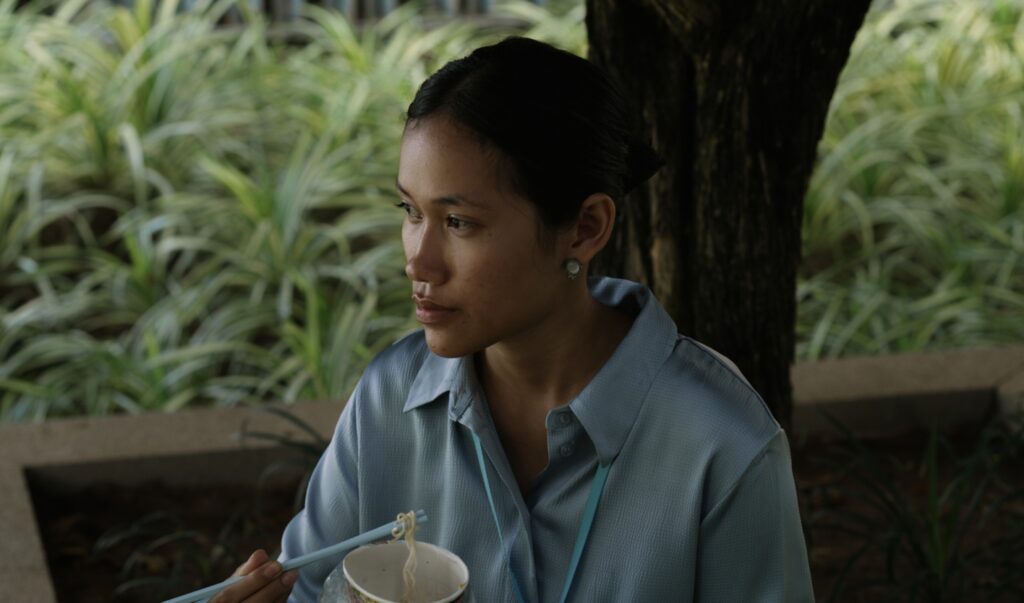
Right from the opening scene of Promised Spaces, there is a synthesis that presents the space in which the action will unfold — the surroundings of a residential complex that blends urbanity and nature — as well as the moral and political axis that runs through the work of Serbian filmmaker Ivan Marković. Here, high-rises — or their skeletal structures — fill the horizon, symbolizing the advance of a voracious and exclusionary modernization. There, the interior of a collective dormitory where workers, compressed into bunk beds, compete for air, silence, and try to sleep. The narrative drama — if it can be called that — lies in the contrast between those who build, the working class, and those who inhabit.
This opening continues with the image of half a dozen clotheslines heavy with laundry, about to be ruined by a sudden downpour, and reveals a narrative interested in thinking about this constructed setting — once a fishing village — as more than mere location. What is at stake, ultimately, is the invisible architecture and urbanism of a neoliberal economic system that redistributes bodies according to an inhumane and degrading logic. In this respect, Sokun is less an individual than a metonym for the working class. Plagued by insomnia, he wanders through the darkness of the neighborhood, reflecting alongside other workers on life, labor, who has the right to sleep, and where they are allowed to do so.
During one such conversation, Sokun hears the phrase “at least you work every day,” whose ambiguity reveals the perversity of an economy that transforms the exploitation of labor into a privilege. The worker’s life is appropriated by capital, becoming analogous to a brick within the structure of a building. At this point, the narrative introduces Seda, the first tenant of the condominium, and the film seems to shift toward a more conventional class struggle. Seda argues with the real estate agent, then with the restaurant owner.
Yet Promised Spaces does not limit itself to class struggle. By emphasizing Seda’s frustration — as the apartment, with its structural flaws and lack of assistance, fails to match its advertised promise — the narrative suggests a continuation of the same exploitative logic, albeit on a different level. Seda is not equivalent to Sokun, but neither is she outside the system that oppresses him. She becomes, instead, a precarious beneficiary of a failed system, someone who has purchased not just a home but a desire for belonging to what the condominium represents.
Marković rejects a simplistic dichotomy between oppressors — invisible or embodied in figures like Seda — and the oppressed. He constructs a panorama of subjects captured by an ambiguous and cruel model of development. The condominium, with its neon façade and nature-integrated leisure areas, is a mirage — as most such developments tend to be — a space of exclusivity that nonetheless encloses and suffocates, even if only temporarily.
The contemplative rhythm, also shaped by Marković, is rooted in slow cinema — a contemporary tradition that evokes, without mimicking, the work of Apichatpong Weerasethakul, in which time seems to stretch beyond the limits of immediate perception. It invites a sensory experience of the heat that permeates the narrative. A heat we do not physically feel, of course, but one that immobilizes and induces workers into a state of semi-consciousness where the boundaries between wakefulness and dreaming blur.
Sleep becomes a recurring motif. Characters who cannot sleep; others who sleep excessively; some who abandon their homes in search of thermal relief in nature; others who wander through the night as if trapped in a climatic and existential limbo — perhaps the narrative is also tentatively linking the predatory capitalism represented by the high-rises with the climate crisis, though this remains uncertain. This oscillation between exhaustion and insomnia constructs a dramaturgy of fatigue: the exhausted body — which longs only to dive into the rooftop pool — as both instrument of labor and site of resistance, defending what remains private within a market-driven economy.
There is a particularly effective sequence in which Seda, impatient, invades the private space of a restaurant and its owner. The act is violent in that it reproduces the logic of appropriating labor. The film, however, is less a social diagnosis than a reflective and sensory experience above all. What existed before these concrete giants occupied the landscape? Or how the night renders the neighborhood ghostly. In this way, the final lingering image — the public river contrasted with the private pool — encapsulates the film’s ambitions, moving beyond didacticism toward sensoriality.
Promised Spaces is not merely a film about precarious construction workers or about the transformation of a fishing village into an upper-middle-class hub. Above all, it is a rigorous reflection on the meaning of dwelling and belonging within the neoliberal logic of the contemporary world. And the inability to find rest in an exhausting world becomes the core of this discussion. Sleep may well be the last remaining luxury, and the right to dream the worker’s final form of resistance in a world where housing is neither a promise nor a right granted to all.


Crítico de cinema filiado a Critics Choice Association, à Associação Brasileira de Críticos de Cinema, a Online Film Critics Society e a Fipresci. Atuou no júri da 39ª Mostra Internacional de Cinema em São Paulo/SP, do 12º Fest Aruana em João Pessoa/PB, do 24º Tallinn Black Nights Film na Estônia, do 47º TIFF – Festival Internacional de Cinema em Toronto. Ministrante do Laboratório de Crítica Cinematográfica na 1ª Mostra Internacional de Cinema em São Luís (MA) e Professor Convidado do Curso Técnico em Cinema do Instituto Estadual do Maranhão (IEMA), na disciplina Crítica Cinematográfica. Concluiu o curso de Filmmaking da New York Film Academy, no Rio de Janeiro (RJ) em 2013. Participou como co-autor dos livros 100 melhores filmes brasileiros (Letramento, 2016), Documentário brasileiro: 100 filmes essenciais (Letramento, 2017) e Animação Brasileira – 100 Filmes Essenciais (Letramento, 2018). Criou o Cinema com Crítica em fevereiro de 2010 e o Clube do Crítico em junho de 2020.