
Crítica em português
Este documentário recém exibido no Festival de Cinema de San Francisco poderia conduzir o espectador às armadilhas já conhecidas de narrativas iguais a esta. Uma que retrata o talento artístico de Tim Blevins, sua queda pelo vício em drogas e, quem sabe, sua redenção e reencontro com os palcos. Esses pontos podem até estar presentes, mas a direção paciente de Javid Soriano recusa essa estrutura clichê em favor de uma abordagem mais instável e, por isto, honesta. Javid observa Tim, um personagem que, como aqueles que interpretou e cantou nos palcos da ópera, não cabe em uma descrição simplificada.
Tim Blevins é um cantor lírico com formação erudita, com talento natural lapidado em instituições de prestígio e nos palcos de ópera do mundo inteiro. Apresentado ao espectador nas ruas da cidade, conduzindo seu carrinho de mercado e ocupando as ruas, os metrôs e os espaços públicos de forma geral, Tim é a coexistência paradoxal entre passado e presente, entre memória e realidade. O ato de observar para além da rotina diuturna, em direção ao peso da voz, da memória e das consequências de suas ações é o que diferencia a estrutura e estudo de personagem contido no documentário.
O que poderia ser tratado como um espetáculo da decadência, especialmente em se tratando de um homem negro que ascendeu em um campo majoritariamente branco e excludente como o da ópera, é deliberadamente deslocado. Javid não está interessado em produzir um filme sobre queda, tampouco sobre superação. Em vez disso, ele constrói, ao longo de um espaço de uma década, um retrato organizado e desorganizado pela persistência. A do vício, a da arte, a dos lamentos afetivos que atravessam a trajetória de Tim desde a infância, vide o relacionamento com o pai e o distanciamento dos filhos.
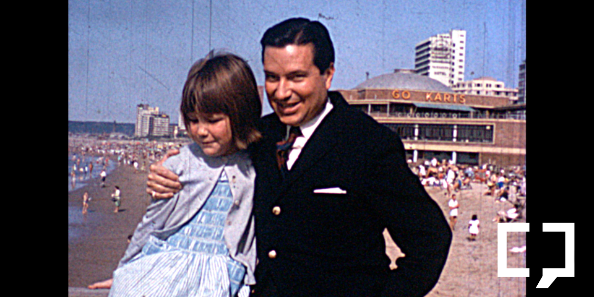
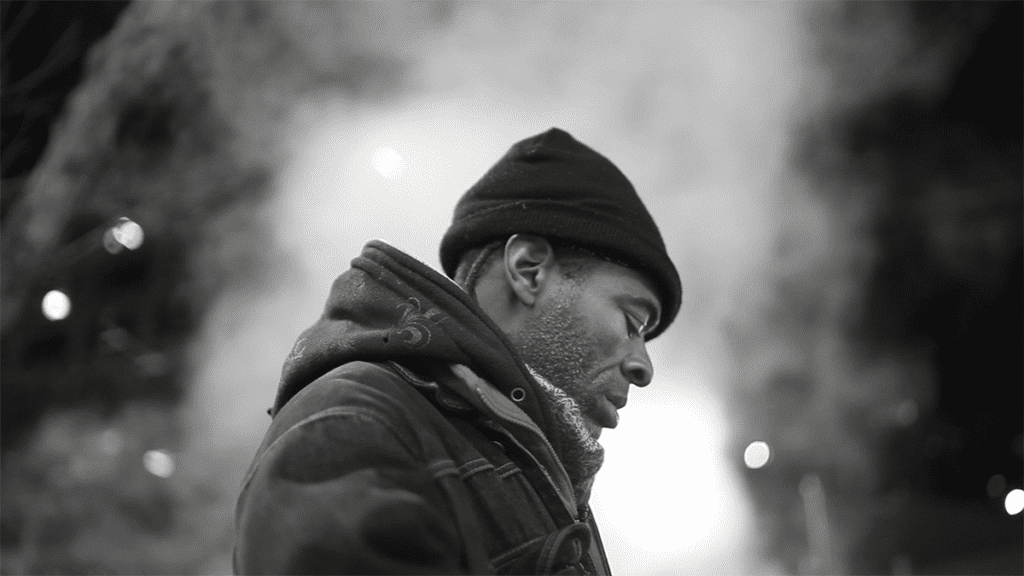
Essa recusa de um documentário redentor se materializa, sobretudo, na maneira como o filme articula tempo e imagem. O uso do preto e branco para o presente é contrastado com o passado em cores. A fotografia não é somente estilo, é uma estratégia narrativa que inscreve a experiência de Tim em uma espécie de suspensão temporal. O preto e branco congela o presente, adensa-o, endurece-o, inclusive com momentos que beiram o expressionismo. Já as cores que saturam o passado não sugerem uma lembrança idealizada, mas a ruptura vista de forma cinematográfica. O que havia e não há mais.
Nesse sentido, a própria cidade de São Francisco assume um papel fundamental como uma estrutura que evidencia as contradições: a proximidade entre a riqueza e a miséria, entre o edifício da ópera e as ruas onde Tim sobrevive. O filme inteligentemente não verbaliza essas tensões. Elas somente estão apresentadas em uma encenação que, confesso, deve ter sido um esforço artístico caótico e, acredito, de reunir peças e organizá-las, mas, ainda assim, não encontrar uma imagem decisiva. Uma encenação que emerge do corpo de Tim ou de sua voz, e que ecoa nos túneis dos metrôs e das calçadas, para a surpresa dos passantes que não imaginariam que um homem negro, miserável, em situação de rua, poderia ter a voz de um virtuoso.
Nesse aspecto, as peças que Tim interpreta funcionam como uma espécie de monólogo interior tornado voz. Uma tradução emocional de estados que a verbalização tornaria expositórios. A exposição pela música, tão cara à ópera, que expressa estados emocionais pelo tom da voz do intérprete, complexifica uma leitura moralizante do estado contemporâneo de Tim. Ele não só é um dependente químico, nem um morador de rua. Antes de mais nada, ele é um artista cuja arte ainda reverbera por entre suas ruínas existenciais.
Ao mesmo tempo, o filme não romantiza essa condição. Há, na abordagem de Javid, uma ética que impede tanto a exploração quanto a romantização. Isso se manifesta, por exemplo, na forma como a câmera se posiciona diante de seus momentos de maior vulnerabilidade: as recaídas, as tentativas frustradas de reconexão com os filhos, os momentos em que teima desistir. Essa escolha narrativa se torna mais relevante quando se pensa no pano de fundo estrutural e no fato de a trajetória de Tim estar imbricada em questões mais amplas, desde a já mencionada presença de um homem negro em um espaço elitizado, até os ciclos de violência, dependência e a difícil reinserção nos círculos sociais.
Esses elementos atravessam Tim, embora não o expliquem. Ele continua um mosaico. Um ser em transformação a olhos vistos. Um sujeito incompleto que caminha pela estrada da sobriedade, e às vezes falha, que tenta se reaproximar dos seus, embora o contexto o impeça ou mesmo um aspecto mais profundo em seu íntimo. Um homem que luta contra demônios que vão e vem, e que não podem ser vencidos, talvez só haja o caminho da negociação com eles. E a ópera se torna um destes demônios, em como representa um ontem glorioso, agora distante, enquanto também sejuma forma de sobrevivência, de afirmação de si.
Figaro Up, Figaro Down repele leituras simplistas. Além de não ser uma tradicional história de ascensão e queda, queda e superação, este também não é uma história de retorno ao começo, mas de recomeço. A voz de Tim, marcada pela idade, pelo desgaste e pelas drogas, já não é mais a mesma. O seu corpo, fisicamente debilitado, também não é mais do artista que fora um dia. O desgaste é a matéria prima e experiência que a narrativa proporciona. O desgaste provocado pela vida, encarado não com condescendência, comiseração, julgamento. Uma abordagem que observa, escuta e, por fim, confia na complexidade do espectador de reconhecê-lo em sua totalidade, apesar de sua incompletude e irresolução.
Nesse sentido, Figaro Up, Figaro Down não se revela um instrumento de expiação ou explicação, mas um espaço de encontro, entre autor (diretor) e sujeito (personagem). Um encontro caracterizado pela fricção entre a maneira como o autor decide olhar para o sujeito, e este decide olhar para si. Ambos os olhares orientam o nosso. E, talvez, em todo este processo, o melhor mesmo está em não oferecer finais e respostas fáceis. Até alcançamos um ponto satisfatório, antes de pararmos diante de uma porta aberta. No papel de observador, mais até do que de participante, o ato derradeiro do documentarista é o de saber o momento certo de desligar a câmera.
Javid Soriano gentilmente respondeu algumas perguntas e cujas respostas transcrevo abaixo, para guiar a compreensão e o olhar de vocês para o filme:
Márcio Sallem: Houve momentos em que você sentiu que Tim estava performando para o próprio filme, e como você navegou essa linha entre autenticidade e autoapresentação?
Javid Soriano: A primeira coisa que me chamou atenção em Tim foi sua fanfarronice, mesmo antes de eu saber que ele era cantor de ópera. Mas, à medida que fui conhecendo melhor diferentes lados dele, fiquei impressionado com o quanto podia ser emocionalmente honesto — o quanto tinha consciência dos próprios erros, o quanto conseguia ser vulnerável tanto comigo quanto diante da câmera.
Onde quer que estivessem as emoções de Tim, ele as expressava por completo. E acho que isso vinha do teatro — ele é tão intrinsecamente conectado à ópera e à performance que, para ele, sentir algo profundamente e performar esse sentimento eram atos quase inseparáveis. Não existia um lado “performático” de Tim e outro “real”. Era tudo performance e tudo real ao mesmo tempo.
E, com o tempo, percebi que isso se estendia muito além da expressão emocional. Tim vivia sua vida como uma narrativa em desenvolvimento, cuja trama ainda não havia sido resolvida. Ele frequentemente perguntava: “Minha vida é uma tragédia… ou um triunfo?”
Essa ideia de Tim vivendo dentro da própria narrativa se tornou muito importante para mim como cineasta. Em vez de remover a performance em busca de uma autenticidade mais “pura”, comecei a me interessar pela forma como a própria performance podia se tornar uma forma de verdade.
M.S. Como este foi um documentário de longa duração, de que maneira você mudou ao longo desses anos, e como isso afetou sua relação com Tim?
J. S. Nós éramos pessoas completamente diferentes quando nos conhecemos. O filme mostra claramente como Tim muda com o passar do tempo, mas o que o público nunca vê é o quanto eu também mudei durante esses mesmos anos.
E, quando algo leva mais de uma década para ser realizado, a vida acontece muitas vezes ao longo desse processo. Crises pessoais acontecem. Perdas acontecem. E, por mais que eu tentasse entrar no espaço das filmagens com clareza mental e profissionalismo, às vezes isso era impossível. Tim era extremamente perceptivo, e certamente houve momentos em que percebeu que algo estava errado comigo. O que me impressionava era que, mesmo travando sua própria guerra existencial — muito mais urgente em termos materiais —, ele ainda parava para se oferecer para conversar sobre os meus problemas.
E não apenas ele. Muitas das pessoas que conhei vivendo nas ruas eram assim.
Não quero generalizar, mas passei a perceber que pessoas que foram levadas a se sentir invisíveis frequentemente se tornam extraordinariamente atentas ao sofrimento dos outros. Algumas das pessoas mais sensíveis e emocionalmente perceptivas que já encontrei eram pessoas em situação de rua.
Nunca vou esquecer um momento depois de uma filmagem difícil com Tim. Eu estava voltando para casa completamente perdido em pensamentos, abalado, quando uma mulher sentada na calçada gritou:
“Ei, senhor, você deixou cair uma coisa!”
Comecei a checar os bolsos e olhar ao redor.
Ela apontou: “Bem ali.”
Olhei para baixo. Nada.
Perguntei: “O que foi que eu deixei cair?”
Ela sorriu e respondeu:
“O seu sorriso.”
E, claro, eu sorri imediatamente.
Ela exclamou:
“Aí está!”
Experiências assim me transformaram profundamente.
Existe ainda outra camada nisso tudo — passar anos imerso em ambientes de sofrimento quase constante cobra um preço psicológico enorme, para o qual eu simplesmente não estava preparado. E depois editar esse sofrimento e cenas de comportamento autodestrutivo repetidas vezes cobra outro preço completamente diferente. Torna-se impossível não se sentir cúmplice, não perder noites de sono sabendo que sua prática criativa exige que você não intervenha. Você é forçado a uma posição extremamente passiva, assistindo a uma pessoa — ou a um grupo de pessoas — se destruindo ao longo de um grande período de tempo, e às vezes parecia como observar um trem descarrilar em câmera lentíssima. E, no fim, por mais que eu quisesse intervir, também entendia que eu não podia oferecer a Tim algo capaz de mudar fundamentalmente sua vida ou as forças maiores que a moldavam.
Acho que o documentário contém dilemas morais reais que nunca se resolvem completamente. O máximo que posso esperar é que o filme não finja possuir respostas fáceis — que coloque o espectador dentro dos dilemas morais do ato de testemunhar e o force a fazer as mesmas perguntas éticas que cercam a fotografia e o cinema documentais desde a invenção da câmera: o que significa testemunhar eticamente o sofrimento de outra pessoa? Como navegamos, enquanto cidadãos, a linha entre testemunhar de maneira tão passiva que nos tornamos cúmplices do sofrimento e, por outro lado, nos recusarmos completamente a testemunhá-lo?
M.S. Como surgiu a linguagem visual em preto e branco?
J. S. A estética em preto e branco surgiu quase imediatamente. Embora o filme tenha sido filmado digitalmente, as imagens do presente foram captadas nativamente em preto e branco desde o início.
Na época, eu estava obcecado em fotografar e filmar a cidade à noite. Via muitas fotografias de rua de Brassaï e Weegee. Então conheci Tim. Depois de descobrir que eu era cineasta, ele achou que seria incrível cantar árias de ópera em preto e branco pelas ruas de San Francisco. Nós dois sentimos imediatamente que esse tipo de imagem tinha força.
Naquele momento, eu não fazia ideia de que o projeto acabaria contendo enormes quantidades de material de arquivo — quase tudo em cores, além de entrevistas tradicionais com a família de Tim. E, honestamente, parte do motivo pelo qual o filme levou tanto tempo para ser montado foi justamente tentar descobrir como todas essas peças poderiam coexistir de forma coerente em um longa-metragem.
O que acabou conectando todos os elementos — as cenas de rua em preto e branco, o material de arquivo colorido, as entrevistas e os interlúdios musicais — foi recorrer ao que parecesse espiritualmente verdadeiro para cada momento específico.
Por exemplo, há uma sequência que combina o momento documental mais “real” do filme com um de seus momentos mais conscientemente teatrais. Tim acabou de sair da prisão no dia em que seus filhos deveriam vê-lo pela primeira vez em anos. Pouco depois, o filme subitamente se transforma em uma ópera: a câmera acompanha Tim empurrando seu carrinho por um beco em um longo plano-sequência enquanto ele canta a ária de Verdi Credo in un dio Crudel (“Eu acredito em um Deus cruel”).
Convencionalmente, esses momentos não deveriam funcionar juntos de forma alguma. A performance da ária foi obviamente encenada e filmada em um momento completamente diferente daquele em que ele sai da prisão. Ainda assim, emocionalmente, a justaposição funciona porque a ária expressa exatamente o que Tim está vivendo internamente naquele instante, e sua performance captura o desgaste e a frustração que qualquer pessoa sentiria naquela situação.
Então acho que a verdade emocional acabou importando mais do que o realismo estrito ou a cronologia. O público aceita enormes descontinuidades de espaço, tempo e lógica desde que a continuidade emocional pareça verdadeira.
M.S. Existe algo de radical em deslocar a ópera das instituições elitizadas para o espaço público?
J.S. Sim — esse foi um dos fascínios originais por trás do filme, e tudo começou com a figura de Fígaro.
Quando conheci Tim, ele vendia quinquilharias nas redondezas do Civic Center, bem diante da prefeitura de San Francisco e da Ópera de San Francisco. Ele começou a falar sobre Fígaro, dizendo que as pessoas frequentemente esquecem que Fígaro é um malandro de rua. A famosa ária Largo al factotum fala sobre um sujeito esperto navegando pela cidade através de arrogância, carisma e instinto de sobrevivência. Ele é um resolvedor de problemas, um trapaceiro — alguém que transita entre diferentes mundos sociais usando inteligência e personalidade para ascender.
Isso destravou tudo. A casa de ópera deixou de parecer completamente separada das ruas ao redor. E mais do que isso: através de Tim, as próprias ruas já remixavam a ópera em seus próprios termos. Onde mais você ouviria Pusherman, de Curtis Mayfield, entrelaçada com o Fígaro de Rossini, senão através de alguém como Tim nas ruas?
Mas, no fim, acho que o gesto radical do filme não é simplesmente deslocar a ópera para as ruas, mas questionar por que certas formas de experiência humana são culturalmente elevadas à categoria de “arte”, enquanto outras são ignoradas como ruído de fundo ou descartadas como algo vulgar. A ópera nos obriga a parar, sentar e absorver a importância emocional e cultural do palco, da música, da emoção.
E acho que o filme acaba sugerindo que as vidas desses exilados dormindo do lado de fora da prefeitura e da casa de ópera já possuíam escala operística, tragédia e significado muito antes de qualquer câmera ser apontada para eles.
M.S. Qual foi a coisa mais difícil de deixar de fora da montagem final?
Grande parte envolvia material musical — performances incríveis que simplesmente não cabiam no filme. Embora, honestamente, neste momento eu ainda esteja tentando incorporar parte desse material cortado antes que a versão final seja fechada. Então veremos se mais alguns “queridinhos” sobrevivem no fim das contas.
M.S. Alguns poderiam argumentar que transformar sofrimento em cinema corre o risco de romantizar a dor. Como você responde a isso?
J.S. Acho que o risco de romantizar o sofrimento no cinema de não ficção é inevitável.
Por um lado, você precisa de algum tipo de estrutura estética para dar perspectiva ao sofrimento e permitir que ele se torne compreensível ou relacionável. Mas, por outro, se o material se torna excessivamente filtrado ou moldado, o sofrimento é achatado em algo meramente simbólico ou imediatamente consumível. Corre-se o risco de transformar tudo em “pornografia da pobreza”.
O equilíbrio é extremamente delicado. E, para mim, a única forma de lidar com essa tensão é abraçar plenamente a ambiguidade e a complexidade da situação. Momentos de sofrimento devem desacelerar mental e emocionalmente o espectador, resistindo a qualquer integração fácil em estruturas morais convencionais.
Por exemplo, existe uma cena de uso de drogas em que Tim discute como o ato de injetar drogas pode se tornar uma forma profunda de intimidade entre amantes. Na superfície, o uso de drogas é claramente autodestrutivo. Mas, emocionalmente, ele está articulando algo profundamente humano — um desejo de conexão, ritual, ternura, até transcendência.
Isso não justifica o ato. Mas certamente o torna mais complexo.
Então acho que o objetivo não é evitar completamente a estetização do sofrimento ou do comportamento autodestrutivo — porque o cinema inevitavelmente estetiza tudo o que toca —, mas sim tornar impossíveis leituras simplistas dessas experiências.
English review
This documentary, recently screened at the San Francisco International Film Festival, could easily lead viewers into the familiar traps of narratives like this one: a story about Tim Blevins’ artistic talent, his descent into drug addiction and, perhaps, his redemption and return to the stage. Those elements may indeed be present, but Javid Soriano’s patient direction rejects that clichéd structure in favor of a more unstable — and therefore more honest — approach. Soriano observes Tim, a character who, much like the roles he once performed and sang on opera stages, cannot be contained within a simplified description.
Tim Blevins is a classically trained opera singer whose natural talent was refined in prestigious institutions and on opera stages around the world. Introduced to the audience on the streets of the city, pushing a shopping cart and occupying streets, subways and public spaces in general, Tim embodies the paradoxical coexistence between past and present, between memory and reality. The act of observing beyond the ordinary routines of daily life, toward the weight of voice, memory and the consequences of his actions, is what distinguishes the documentary’s structure and character study.
What could have been treated as a spectacle of decay — especially in the case of a Black man who rose within a predominantly white and exclusionary field such as opera — is deliberately displaced. Soriano is not interested in making a film about downfall, nor about triumph over adversity. Instead, over the course of a decade, he constructs a portrait both organized and disorganized by persistence: the persistence of addiction, of art, of emotional wounds that have haunted Tim’s trajectory since childhood, as evidenced by his relationship with his father and his estrangement from his children.
This refusal of a redemptive documentary materializes above all in the way the film articulates time and image. The use of black and white for the present is contrasted with the past in color. The cinematography is not merely stylistic; it is a narrative strategy that inscribes Tim’s experience within a kind of suspended temporality. The black and white freezes the present, thickens it, hardens it — at times approaching expressionism. Meanwhile, the saturated colors of the past do not suggest idealized memory, but rather rupture rendered cinematically: what once existed and no longer does.
In this sense, the city of San Francisco itself assumes a fundamental role as a structure that exposes contradictions: the proximity between wealth and misery, between the opera house and the streets where Tim survives. The film intelligently avoids verbalizing these tensions. They are simply presented through a staging that, I confess, must have required a chaotic artistic effort — an attempt to gather scattered pieces and organize them, while still never arriving at a definitive image. A staging that emerges from Tim’s body or from his voice, echoing through subway tunnels and sidewalks, to the astonishment of passersby who would never imagine that a poor, homeless Black man could possess the voice of a virtuoso.
In this respect, the opera pieces Tim performs function as a kind of interior monologue made vocal. An emotional translation of states that straightforward verbalization would render merely expository. This exposure through music — so intrinsic to opera, where emotional states are expressed through the performer’s vocal tone — complicates any moralizing reading of Tim’s contemporary condition. He is not merely a drug addict, nor simply a homeless man. Above all else, he is an artist whose art still reverberates through the ruins of his existence.
At the same time, the film never romanticizes this condition. There is, in Soriano’s approach, an ethical sensibility that prevents both exploitation and romanticization. This manifests, for instance, in the way the camera positions itself before Tim’s moments of greatest vulnerability: the relapses, the failed attempts to reconnect with his children, the moments in which he stubbornly seems ready to give up. This narrative choice becomes even more significant when considered against the broader structural backdrop and the fact that Tim’s trajectory is intertwined with larger issues, from the already mentioned presence of a Black man within an elitist artistic sphere to cycles of violence, addiction and the difficulty of reintegration into social life.
These elements pass through Tim, though they do not explain him. He remains a mosaic. A being visibly in transformation. An incomplete subject walking the road toward sobriety — and sometimes failing — trying to reconnect with those closest to him, even as circumstance or perhaps something deeper within himself prevents it. A man battling demons that come and go, demons that perhaps cannot be defeated, only negotiated with. Opera itself becomes one of those demons, representing a glorious yesterday now distant, while simultaneously remaining a means of survival and self-affirmation.
Figaro Up, Figaro Down repels simplistic readings. Beyond not being a conventional story of rise and fall, fall and redemption, this is also not a story about returning to the beginning, but about beginning again. Tim’s voice, marked by age, exhaustion and drugs, is no longer the same. His physically weakened body is no longer that of the artist he once was. Wear becomes the raw material and the experience the narrative offers. The wear imposed by life, approached neither with condescension, pity nor judgment. Instead, the film observes, listens and ultimately trusts in the viewer’s capacity to recognize Tim in his totality, despite his incompleteness and irresolution.
In this sense, Figaro Up, Figaro Down reveals itself not as an instrument of expiation or explanation, but as a space of encounter — between author (director) and subject (character). An encounter characterized by the friction between the way the filmmaker chooses to look at the subject and the way the subject chooses to look at himself. Both gazes guide our own. And perhaps, throughout this entire process, the greatest virtue lies precisely in refusing to offer easy endings or simple answers. We arrive at a satisfying point before stopping in front of an open door. In the role of observer — perhaps even more than participant — the documentarian’s final act is knowing the right moment to turn the camera off.
Javid Soriano kindly answered a few questions, whose responses I transcribe below to help guide your understanding and perspective on the film:
Márcio Sallem: Were there moments when you felt Tim was performing for the film itself, and how did you navigate that line between authenticity and self-presentation?
Javid Soriano: The first thing that struck me about Tim was his bravado, even before I knew he was an opera singer. But as I got to know him better and saw different sides of him, I was struck by how emotionally honest he could be — how self-aware he was about his mistakes, how vulnerable he could be both around me and on camera.
Wherever Tim’s emotions were, he expressed them completely. And I think that came from the theater — he’s so intrinsically connected to opera and performance that for him, feeling something deeply and performing it are almost inseparable acts. There wasn’t one side of Tim that was “performative” and another that was “real.” It was all performance and all real at the same time.
And over time, I realized this extended far beyond emotional expression. Tim experienced his life as an unfolding narrative whose plotline was still unresolved. He would often ask: “Is my life tragedy…or triumph?”
That idea of Tim living inside his own narrative became really important to me as a filmmaker. Instead of stripping away performance in search of some purer authenticity, I became interested in how performance itself could become a form of truth.
M.S. Since this was a long-term documentary, how did you change during those years, and how did that affect your relationship with Tim?
J.S. We were both completely different people when we first met. The film visibly shows how Tim changes over time, but what the audience never sees is how much I changed during those same years.
And when something takes over a decade to make, life happens many times over during that process. Personal crises happen. Loss happens. And no matter how hard I tried to enter the shooting space clear headed and professional, sometimes that was impossible. Tim is extremely perceptive, and there were definitely times he sensed something was wrong with me. What struck me was that even while fighting his own existential war — one that was far more materially urgent — he would still stop and offer to talk about my problems.
And not just him. Many people I met living on the street were like that.
I don’t want to generalize, but I’ve come to see that people who have been made to feel invisible often become extraordinarily attentive to the suffering of others. Some of the most attentive and emotionally perceptive people I’ve ever encountered were unhoused.
I’ll never forget one moment after a difficult shoot with Tim. I was walking home completely lost in thought, upset, and a lady sitting on the sidewalk yelled:
“Hey sir, you dropped something!”
I started checking my pockets and looking around.
She pointed, “Right there.”
I looked down. Nothing.
I said to her, “What did I drop?”
She smiled and said:
“Your smile.”
And of course, I smiled immediately.
She exclaimed:
“There it is!”
Experiences like that fundamentally changed me.
There’s another layer too — spending years immersed in environments of near-constant suffering takes an enormous psychological toll that I was just not prepared for. And then editing that suffering and scenes of self-destructive behavior over and over again takes another toll entirely. It becomes impossible not to feel complicit, not to lose real sleep knowing that your creative practice requires you to not intervene. You’re forced into a very passive position of watching a person, or a group of people destroying themselves over a long period of time, and sometimes it felt like watching a train fall off the tracks in super slow motion. And ultimately, as much as I wanted to intervene, I also understood that I could not give Tim something that could fundamentally change his life or the larger forces shaping it.
I think documentary filmmaking contains real moral dilemmas that never fully resolve themselves. The best I can hope for is that the film doesn’t pretend to have easy answers — that it places the viewer inside the moral dilemmas of witnessing, and forces viewers to ask the same ethical questions surrounding documentary photography and film since the invention of the camera: what does it mean to ethically witness another person’s suffering? How do we navigate, as citizens, the line between witnessing so passively that we become complicit in suffering, versus refusing to witness it at all?
M.S. How did the black-and-white visual language emerge?
J.S. The black-and-white aesthetic emerged almost immediately. Even though the film was shot digitally, the present-day footage was captured natively in black and white from the very beginning.
At the time, I was obsessed with photographing and filming the city at night. I was looking at a lot of Brassaï and Weegee street photography. Then I met Tim. After learning I was a filmmaker, he thought it would be incredible to sing opera arias in black and white on the streets of San Francisco. We both immediately felt that kind of imagery had power.
At that point I had absolutely no idea the project would contain massive amounts of archival footage — almost all of it in color, or talking head interviews with Tim’s family. And honestly, part of why the film took so long to edit was trying to discover how all of these pieces could coexist coherently over a feature length film.
What ultimately connected all of the elements — the black and white street scenes, color archival footage, talking head interviews, and musical interludes — was defaulting to whatever felt spiritually true to a given moment.
For example, there’s a sequence that combines the “realest” documentary moment in the film with one of its most self-consciously theatrical moments. Tim has just gotten out of jail on the day his children were supposed to see him for the first time in years. Shortly afterward, the film suddenly transforms into an opera: the camera tracks Tim pushing his cart down an alleyway in a long take as he sings the Verdi aria Credo in un dio Crudel (“I believe in a cruel God”).
Conventionally, those moments should not work together at all. The aria performance was obviously staged and shot at a completely different point in time from when he gets out of jail. And yet emotionally the juxtaposition works because the aria expresses exactly what Tim is experiencing internally in the moment, and his performance itself captures the world weariness and frustration that anyone would feel in this moment.
And so I think emotional truth ultimately mattered more than strict realism or chronology. Audiences will accept enormous discontinuities in space, time and logic as long as the emotional continuity feels true.
M.S. Is there something radical about relocating opera from elite institutions into public space?
J.S. Yes — that was one of the original fascinations behind the film, and everything began with the character of Figaro.
When I met Tim, he was selling knickknacks around Civic Center in full view of San Francisco’s City Hall and the San Francisco Opera House. He started talking about Figaro, saying that people often forget Figaro is a street hustler. The famous aria Largo al factotum is about a streetwise guy navigating the city through swagger, charisma, and survival instincts. He’s a fixer and a schemer — someone moving between different social worlds using wit and personality to work his way to the top.
This unlocked everything. The opera house no longer felt fully separate from the streets surrounding it. And more — through Tim, the streets were already remixing opera on their own terms. Where else would you ever hear Curtis Mayfield’s Pusherman woven together with Rossini’s Figaro other than through someone like Tim on the streets?
But ultimately, I think the radical gesture of the film is not simply relocating opera into the streets, but questioning why certain forms of human experience are culturally elevated into “art,” while others are ignored as background noise or dismissed as lowbrow. Opera compels us to stop, sit down, and take in the emotional and cultural significance of the stage, the music, the emotion.
And I think the film ultimately suggests that the lives of these exiles sleeping just outside City Hall and the opera house already possessed operatic scale, tragedy, and meaning long before anyone pointed a camera at them.
M.S. What was the most difficult thing to leave out of the final cut?
J.S. A lot of it involved musical material — incredible performances that simply couldn’t fit into the film. Though honestly, as of this moment, I’m still actively trying to incorporate some of the cut material before the final version is locked. So we’ll see if a few more “darlings” can survive after all.
M.S. Some might argue that turning hardship into cinema risks romanticizing suffering. How do you respond to that?
J.S. I think the risk of romanticizing suffering in nonfiction filmmaking is unavoidable.
On the one hand, you need some kind of aesthetic framework to give suffering perspective and to allow it to become understandable or relatable. But on the other hand, if the material becomes over-filtered or over-shaped, suffering gets flattened into something merely symbolic or immediately consumable. It runs the risk of becoming poverty porn.
The balance is incredibly delicate. And for me, the only way to navigate that tension is by fully embracing the ambiguity and complexity of the situation. Moments of suffering should slow the viewer down mentally and emotionally, resisting any easy integration into conventional moral frameworks.
For example, there’s a drug use scene where Tim discusses how the act of shooting up can become a profound form of intimacy between lovers. On the surface, the drug use is clearly self-destructive. But emotionally, he’s articulating something deeply human — a desire for connection, ritual, tenderness, even transcendence.
That doesn’t justify the act. But it certainly complicates it.
And so I think the goal is not to avoid the aestheticization of suffering or self-destructive behavior altogether — because cinema inevitably aestheticizes whatever it touches — but rather to make simplistic readings of those experiences impossible.

Crítico de cinema filiado a Critics Choice Association, à Associação Brasileira de Críticos de Cinema, a Online Film Critics Society e a Fipresci. Atuou no júri da 39ª Mostra Internacional de Cinema em São Paulo/SP, do 12º Fest Aruana em João Pessoa/PB, do 24º Tallinn Black Nights Film na Estônia, do 47º TIFF – Festival Internacional de Cinema em Toronto. Ministrante do Laboratório de Crítica Cinematográfica na 1ª Mostra Internacional de Cinema em São Luís (MA) e Professor Convidado do Curso Técnico em Cinema do Instituto Estadual do Maranhão (IEMA), na disciplina Crítica Cinematográfica. Concluiu o curso de Filmmaking da New York Film Academy, no Rio de Janeiro (RJ) em 2013. Participou como co-autor dos livros 100 melhores filmes brasileiros (Letramento, 2016), Documentário brasileiro: 100 filmes essenciais (Letramento, 2017) e Animação Brasileira – 100 Filmes Essenciais (Letramento, 2018). Criou o Cinema com Crítica em fevereiro de 2010 e o Clube do Crítico em junho de 2020.