

Crítica em português
A seleção de filmes em um festival de cinema pode revelar a existência uma ambição temática, narrativa e até estilística que é reconhecível quando colocamos as cartas na mesa. Um bom estudo de caso é este La Bola Negra. Similar a Parallel Tales e Natal Amargo, é um filme de contação de histórias em que a realidade é reimaginada e inscrita na arte; já parecido com outros – e foram muitos! – é um filme de guerra ambientado na Espanha, no ano de 1937, durante o golpe de Estado que daria o poder a Francisco Franco; é também um filme sobre pais e filhos, de certo modo, e ainda um filme sobre identidade ou sexualidade dissidentes – um tema central ou coadjuvante em alguns filmes. Não é absurdo falar que La Bola Negra resume, de certo modo, a seleção deste ano.
Dirigido e escrito por Javier Calvo e Javier Ambrossi, o filme é uma tentativa de mesclar reparação histórica, ficção e memória em um filme ambicioso mas que, a meu ver, parece incapaz de harmonizar plenamente suas histórias paralelas. Ela se estrutura a partir de três histórias distintas, separadas temporalmente, apesar de conectadas pelo tema da sexualidade reprimida, pela necessidade de pertencimento social e, sobretudo, pela arte como um testemunho verídico ou sensível daqueles que a produziram.
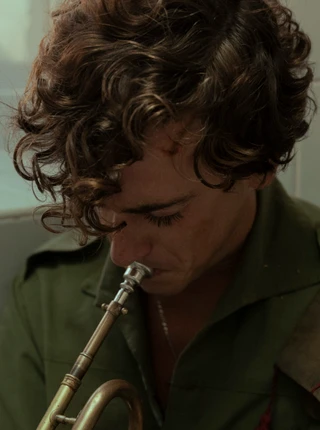
Na primeira dessas histórias, ambientada durante a invasão de Granada pelas forças italianas ligadas ao fascismo de Mussolini, às vésperas da tomada do poder de Franco, acompanhamos um simpatizante do regime, Sebastián, que, para sobreviver, aproxima-se do movimento nacionalista e acaba desenvolvendo uma relação afetiva com um homem politicamente oposto a ele, Rafael. É o segmento mais marcante, até central da narrativa, em como reproduz, na fisicalidade dos corpos masculinos ao estilo de Bom Trabalho, de Claire Denis, na discussão e reflexão do desejo pelo corpo do inimigo e no que é precisa sacrificar de si para permanecer vivo, os temas que interessam os diretores.
Os corpos banhando-se no mar, a maneira como a câmera observa o toque entre os homens e o emprego do espaço natural como um terreno de liberdade e vulnerabilidade evocam o homoerotismo como uma expressão da intimidade e do desejo interrompido. É muito tocante assistir a este romance em um contexto histórico marcado pelo fascismo, porque além de antecipar seu desfecho trágico, ainda recorda que o fascismo é, antes de mais nada, o controle do corpo em todos os aspectos.
A segunda narrativa, a que dá título ao filme, acompanha o jovem Carlos tentando ingressar num grupo cuja lógica de aceitação depende de uma votação simbólica através de bolas brancas e bolas negras. As primeiras representam aceitação; as segundas, rejeição. Um símbolo metonímico sobre a aceitação ou rejeição do indivíduo queer na sociedade e um dispositivo empregado reiteradamente sobre validação e pertencimento; e, de novo, o que o indivíduo precisa sacrificar de si para sobreviver dentro de uma estrutura conservadora.
Carlos sabe que a sua orientação sexual é conhecida pelos pais, personagens que aceitam sua homossexualidade ao mesmo tempo em que tentam educá-lo a vivê-la discretamente, apenas em “ambientes apropriados”. O amor familiar existe, embora o exercício do amor esteja condicionado a Madri, por exemplo. A aceitação, para o filme, exige algum grau de abdicação subjetiva; para participar do que é enxergado como uma elite de notáveis, Carlos precisa negear que é. A bola negra deixa então de representar apenas rejeição externa e transforma-se numa espécie de violência, um mecanismo pelo qual o indivíduo é disciplinado a censurar as partes dele rejeitadas pelas sociedades. Mais uma vez, o fascismo evidencia-se como mecanismo de controle.
Já no tempo presente, acompanhamos Alberto, um sujeito bem resolvido com sua sexualidade, ainda que emocionalmente marcado pela relação conflituosa com a mãe. Ao herdar um material deixado pelo avô, ele inicia uma viagem que gradualmente o conduz não apenas a descobertas familiares, mas também à compreensão de como histórias atravessam gerações. É este o dispositivo de recorte da narrativa e o elo mais fraco dentre as histórias, já que a ideia da busca em direção ao passado, opera um efeito menos emocional e mais ideológico. É o presente que aprende com o ontem, o que as gerações anteriores viveram, e, no caso do movimento queer, os sacrifícios e as violências a que as pessoas foram submetidas em razão de sua orientação sexual.
A ideia é interessante. A história vivida e factual e a história sentida e imaginada como heranças emocionais. Ainda mais por se tratar de uma obra inacabada de Federico García Lorca – morto justamente na Guerra Civil Espanhola. Entretanto, a execução raramente alcança a densidade necessária para que essas conexões adquiram algum impacto que não só racional. O filme compreende racionalmente aquilo que deseja discutir, mas nem sempre encontra uma encenação poderosa para traduzir suas ideias em experiência emocional.
Eu também senti um incômodo relacionado às interpretações. Embora seja compreensível que o elenco esteja preso a interpretações mais contidas e intimidadas por não poder se expressar em uma era de silenciamento, os atores permanecem uma nota abaixo, ou indiferentes, ou introspectivos, em uma melancolia que pode ser confundida com apatia. É exatamente por isso que a breve aparção de Penélope Cruz provoque tamanho impacto e surja como um divisor de águas e um elemento de comparação. A sua presença possui um poder e energia que extravasa em canção, dança e gestualidade.
Enquanto os personagens permanecem introvertidos e excessivamente ensimesmados, Penélope entra em cena como alguém capaz de incendiar o ambiente ao redor. Há mais vida nos 15 minutos em que está em cena do que nos 140 minutos restantes – de um filme não apenas longo mas demasiadamente irregular. O mesmo ocorre, em escala menor, com Glenn Close, cuja participação reforça a discussão sobre a importância de compreender quem eram os autores por trás das obras, sobretudo quando alguns temas constituíam dimensões ocultadas por entrelinhas.
Ainda assim, há algo inevitavelmente frustrante na experiência que tive. Porque embora exista um mérito dos diretores em articular, no roteiro e com relances de poesia visual, suas histórias, a sensação é a de assistir a uma obra que já vi antes – e frequentemente realizada de maneira mais profunda, mais dolorosa e cinematograficamente mais potente.
Eu gosto de como as histórias sobrevivem aos seus autores e quanto de DNA carregam, expressa ou secretamente, de quem os escreveu. O filme compreende que toda narrativa é também uma tentativa de existir, permanecer e expressar desejos, traumas e identidades que a sociedade frequentemente tenta/tentou apagar. Pena que, ao transformar essa reflexão em cinema, a obra permaneça mais próxima de uma contemplação racional do que da experiência emocional que os diretores certamente buscavam.
O filme está na Seleção Oficial do Festival de Cannes 2026.
English review
The selection of films at a film festival can reveal the existence of a thematic, narrative, and even stylistic ambition that becomes recognizable once all the cards are laid on the table. A good case study is La Bola Negra. Similar to Parallel Tales and Bitter Christmas, it is a storytelling film in which reality is reimagined and inscribed into art; much like many others — and there were many — it is also a war film set in Spain in 1937, during the coup d’état that would bring Francisco Franco to power; it is, in a way, also a film about fathers and sons, and equally a film about dissident identities and sexualities — a central or secondary theme in several titles. It would not be absurd to say that La Bola Negra somehow encapsulates this year’s selection.
Directed and written by Javier Calvo and Javier Ambrossi, the film attempts to merge historical reparation, fiction, and memory into an ambitious work that, in my view, never fully manages to harmonize its parallel narratives. It is structured around three distinct stories, separated temporally yet connected through the themes of repressed sexuality, the need for social belonging, and, above all, art as a truthful or sensitive testimony of those who created it.
In the first of these stories, set during the invasion of Granada by Italian forces linked to Mussolini’s fascism, on the eve of Franco’s rise to power, we follow Sebastián, a sympathizer of the regime who, in order to survive, aligns himself with the nationalist movement and eventually develops an emotional relationship with a man politically opposed to him, Rafael. It is the film’s most striking — and perhaps central — segment, particularly in the way it reproduces, through the physicality of male bodies reminiscent of Claire Denis’ Beau Travail, the discussion and reflection on desire for the enemy’s body and on what one must sacrifice of oneself in order to remain alive, themes that clearly interest the directors.
The bodies bathing in the sea, the way the camera observes touch between men, and the use of natural space as a terrain of freedom and vulnerability evoke homoeroticism as an expression of intimacy and interrupted desire. It is deeply moving to witness this romance within a historical context marked by fascism, because beyond foreshadowing its tragic conclusion, it also reminds us that fascism is, above all else, the control of the body in every aspect.
The second narrative, which gives the film its title, follows the young Carlos attempting to join a group whose logic of acceptance depends on a symbolic vote through white balls and black balls. The former represent acceptance; the latter, rejection. It is a metonymic symbol for the acceptance or rejection of the queer individual within society and a device repeatedly employed to discuss validation and belonging — and, once again, what the individual must sacrifice of themselves in order to survive within a conservative structure.
Carlos knows that his sexual orientation is known by his parents, characters who accept his homosexuality while simultaneously trying to teach him to live it discreetly, only within “appropriate environments.” Familial love exists, although the exercise of that love is conditioned — to Madrid, for instance. Acceptance, for the film, demands some degree of subjective abdication; in order to participate in what is perceived as an elite circle of notable individuals, Carlos must deny who he is. The black ball thus ceases to represent mere external rejection and becomes a form of violence, a mechanism through which the individual is disciplined into censoring the parts of themselves rejected by society. Once more, fascism reveals itself as a mechanism of control.
In the present day, we follow Alberto, a man comfortable with his sexuality, though emotionally scarred by his conflicted relationship with his mother. Upon inheriting material left behind by his grandfather, he embarks on a journey that gradually leads him not only toward familial discoveries but also toward an understanding of how stories traverse generations. This serves as the narrative framing device and the weakest link among the stories, since the idea of a search directed toward the past produces an effect that feels less emotional than ideological. It is the present learning from the past, from what previous generations endured and, in the case of the queer movement, the sacrifices and violence people suffered because of their sexual orientation.
The idea is compelling: lived and factual history alongside imagined and emotionally inherited history. Especially considering that the film is based on an unfinished work by Federico García Lorca — himself killed during the Spanish Civil War. Nevertheless, the execution rarely achieves the density necessary for these connections to carry impact beyond the merely rational. The film intellectually understands what it wants to discuss, but it does not always find a powerful enough mise-en-scène to translate its ideas into emotional experience.
I also felt discomfort regarding the performances. While it is understandable that the cast is confined to restrained interpretations, intimidated by an era in which they cannot fully express themselves, the actors often remain one note below — indifferent, introspective, submerged in a melancholy that can easily be mistaken for apathy. This is precisely why Penélope Cruz’s brief appearance has such an impact and emerges as a turning point and a point of comparison. Her presence possesses a force and energy that overflow into song, dance, and gesture.
While the characters remain introverted and excessively withdrawn into themselves, Penélope enters the scene like someone capable of setting the entire environment ablaze. There is more life in the fifteen minutes she occupies on screen than in the remaining 140 minutes — of a film that is not only long but excessively uneven. The same occurs, on a smaller scale, with Glenn Close, whose participation reinforces the discussion about the importance of understanding who the authors behind certain works truly were, especially when some themes existed as dimensions concealed between the lines.
Still, there is something inevitably frustrating about the experience I had with the film. Because although the directors deserve credit for articulating, through the screenplay and flashes of visual poetry, their intertwining stories, the sensation remains that of watching a work I have seen before — and often realized in ways that are deeper, more painful, and cinematographically more powerful.
I appreciate the way stories survive their authors and how much DNA they carry, openly or secretly, from those who wrote them. The film understands that every narrative is also an attempt to exist, endure, and express desires, traumas, and identities that society frequently tries — or once tried — to erase. It is unfortunate that, in transforming this reflection into cinema, the work remains closer to rational contemplation than to the emotional experience the directors were certainly striving to achieve.

Crítico de cinema filiado a Critics Choice Association, à Associação Brasileira de Críticos de Cinema, a Online Film Critics Society e a Fipresci. Atuou no júri da 39ª Mostra Internacional de Cinema em São Paulo/SP, do 12º Fest Aruana em João Pessoa/PB, do 24º Tallinn Black Nights Film na Estônia, do 47º TIFF – Festival Internacional de Cinema em Toronto. Ministrante do Laboratório de Crítica Cinematográfica na 1ª Mostra Internacional de Cinema em São Luís (MA) e Professor Convidado do Curso Técnico em Cinema do Instituto Estadual do Maranhão (IEMA), na disciplina Crítica Cinematográfica. Concluiu o curso de Filmmaking da New York Film Academy, no Rio de Janeiro (RJ) em 2013. Participou como co-autor dos livros 100 melhores filmes brasileiros (Letramento, 2016), Documentário brasileiro: 100 filmes essenciais (Letramento, 2017) e Animação Brasileira – 100 Filmes Essenciais (Letramento, 2018). Criou o Cinema com Crítica em fevereiro de 2010 e o Clube do Crítico em junho de 2020.