
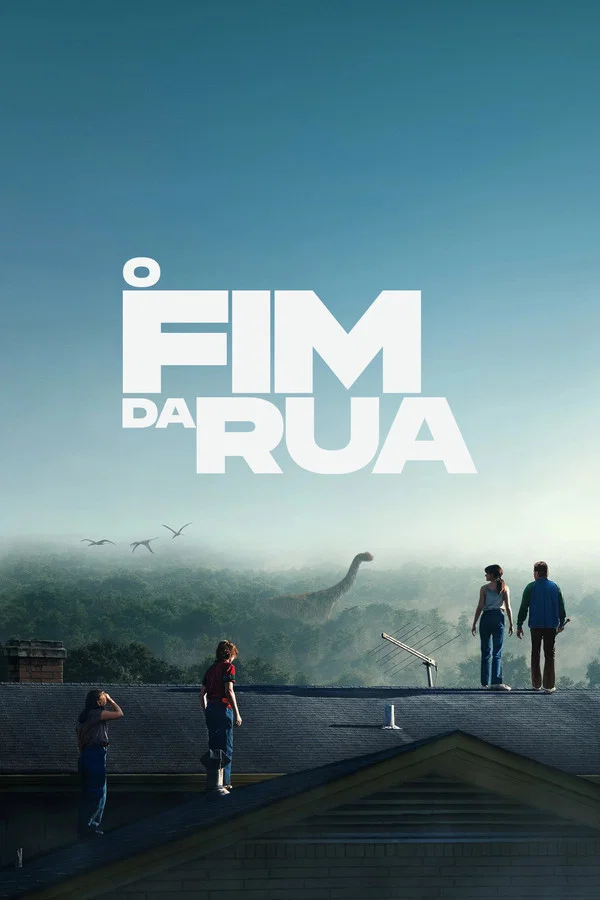
O subúrbio estadunidense transforma-se em um parque de dinossauros
Não há dúvida de que o cinema hollywoodiano contemporâneo está sufocado por grandes franquias, nem de que, quando pensamos em dinossauros nos cinemas, imediatamente lembramos de Jurassic Park ou Jurassic World, uma série de filmes que se transformou em mais um evento cinematográfico como qualquer outro. Este O Fim da Rua caminha no sentido contrário. O ponto de partida pode até pertencer ao de qualquer outra franquia, mas o filme prefere reduzir a escala em favor da intimidade. Ao assisti-lo, tive a sensação de, eu mesmo, ter viajado ao passado, reencontrando os seriados de fantasia dos anos 60 e 70 que eu acompanhava na adolescência, nos canais da TV por assinatura (leia-se: antena parabólica). Produções como Perdidos no Espaço ou Terra de Gigantes em que uma família ou um grupo de pessoas eram arrancados de sua realidade e obrigados a sobreviver em situações inimagináveis, em busca de um jeito de retornar à normalidade. Mas haveria como reaver alguma forma de normalidade? O Fim da Rua revive este encantamento ainda que o misture ao horror.
Escrito e dirigido por David Robert Mitchell (de Corrente do Mal e O Mistério de Silver Lake), a premissa da narrativa é tão simples quanto é eficiente. Uma família estadunidense vive em sua casa suburbana, dentro de uma versão do sonho americano, mesmo que o tal sonho não esteja indo do que jeito que o governo prometeu. O pai, Greg (McGregor), perdeu o emprego e tem entregado pizzas e aceitado trabalhos informais, enquanto a mãe, Denise (Hathaway), permanece à noite no porão escrevendo o seu sonhado best-seller. Os dois filhos adolescentes, Brian (Convery) e Audrey (Stella), vivem suas próprias experiências, alienados das dificuldades enfrentadas pelos pais, até que algo inexplicável acontece: a rua onde moram é transportada para outro tempo, na era pré-histórica, através de um buraco de minhoca. A partir daí, aquele pedaço do subúrbio com aproximadamente 3 km transforma-se em território de sobrevivência, cercado por criaturas que deveriam existir apenas em livros, museus ou nos filmes de Steven Spielberg.
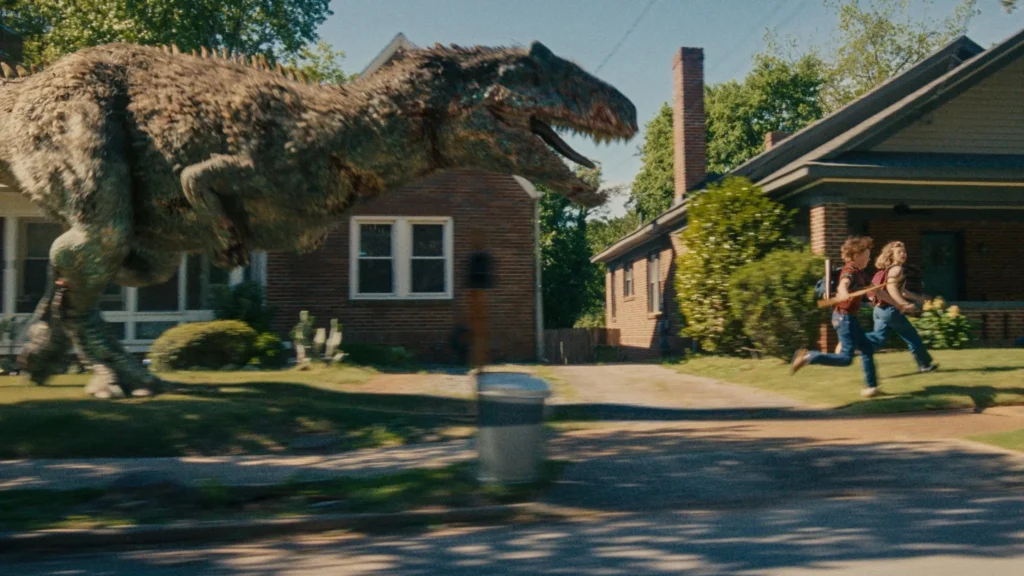
Mitchell constrói sua fantasia de horror a partir da delimitação do mundo; enquanto Spielberg encarou e ostentou a grandiosidade dos antigos ocupantes da Terra. O filme está restrito à geografia apresentada: algumas ruas, casas, carros e famílias que precisam descobrir como continuar vivendo enquanto dezenas de dinossauros passam a ocupar o espaço cotidiano. Com o passar do tempo, nós também passamos a nos localizar naquele mundo hostil. Desse modo, o subúrbio sinônimo de segurança, previsibilidade ou estabilidade dentro do imaginário estadunidense, transforma-se em um espaço de ameaça. Em vez de construir a sua versão de um parque de dinossauros, o diretor transforma o subúrbio em uma filial acidental.
Por isso, o filme abandona qualquer discussão sobre a lógica capitalista que sustentou as maiores discussões de Jurassic Park e World. Se persiste alguma lógica capitalista, está no epílogo da narrativa e na maneira com que a experiência traumática ou fantástica se torna matéria prima para a arte (como, por exemplo, o livro lido por Audrey que relata a experiência dos cosmonautas em direção à Lua). Na realidade, o que interessa à narrativa é algo mais simples. Como uma família pode sobreviver quando o mundo que conhecia deixa de existir? Neste sentido, cada personagem encontra seus mecanismos de afeto e proteção. O pai e a mãe precisam lidar não apenas com os animais, mas com a responsabilidade de proteger os filhos e de reacender a chama de seu casamento; Audrey estabelece, dentro do possível, uma relação de afeição com uma garota que salvou naquele mundo; já Brian está à procura do cachorro da família. Os afetos, na forma daquela família média, são mais importantes do que o que a fantasia proporciona em termos de discussões acessórias.
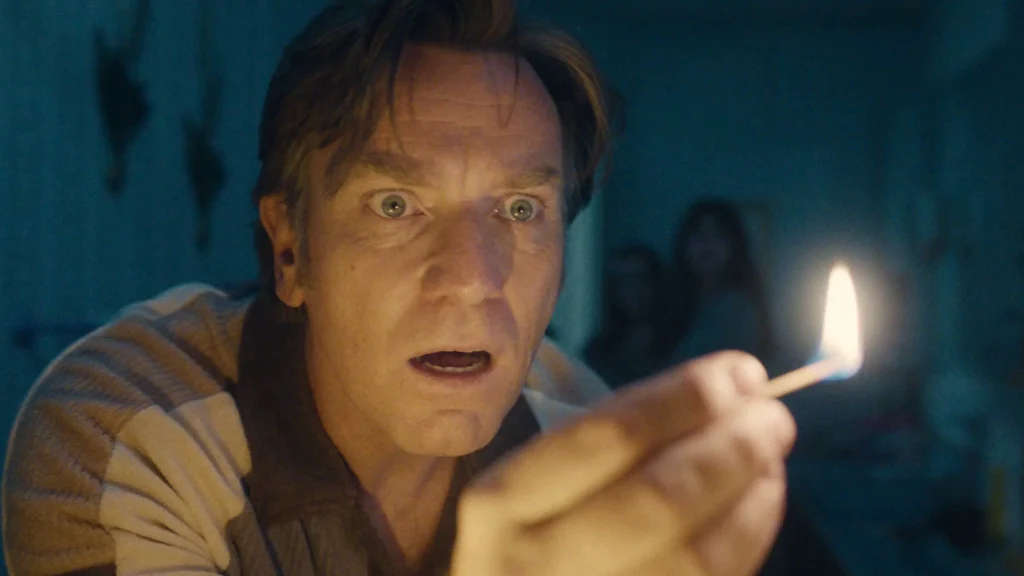
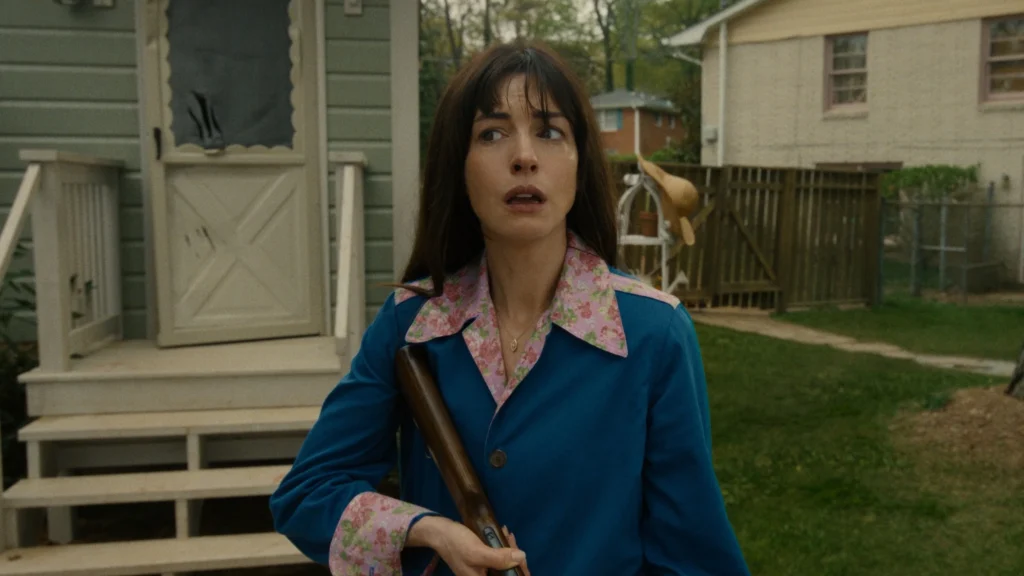
Essa simplicidade permite a Mitchell recuperar um dos prazeres mais básicos do gênero, o prazer de imaginar, traduzido no “E se?”. Se a imaginação parece haver saído de um pesadelo, ainda há instantes de entretenimento e deleite. Assistir a Anne Hathaway disparando a sua espingarda contra um velociraptor pensado de maneira mais próxima do animal que conhecemos hoje, com penas e bico, e Ewan MacGregor desferindo uma marretada contra um Tiranossauro Rex é divertido ante o absurdo da situação. Eu sorri, mas apreensivo. Da mesma forma, há um momento em que os dois se deparam com dois brontossauros copulando que provavelmente permanecerá entre as imagens mais curiosas que vi em um filme de dinossauros. É o prazer jovial de olhar para algo e pensar: “Eu nunca vi isso antes”.
Mitchell povoa esse espaço com uma quantidade considerável de dinossauros. Há os herbívoros inofensivos que atravessam as ruas e trombam em casas e carros, enquanto os carnívoros transformam no maior entrave para a sobrevivência. Há anacondas, tartarugas ou crocodilos gigantes, e inclusive pterodáctilos, em uma . A quantidade é tamanha que o filme eventualmente parece se transformar em um festejo desses animais, embora sinta ser uma escolha mais comercial do que narrativa. Ela é capaz de fragilizar um pouco a tensão, porque a ameaça deixa de depender exclusivamente da construção da tensão, do suspense e do horror, e passa a ser constantemente substituída pela necessidade de mostrar mais uma criatura.
De todo modo, com aproximadamente 100 minutos de duração, a narrativa não parece interessada em justificar a sua existência, nem a dúzia de dinossauros apresentados em um raio de 3 km. Mitchell está à vontade. Ele não precisa pensar em segurar alguns dinossauros para a continuação, nem em deixar portas abertas para que a narrativa continue à frente. Ele pode somente pensar em uma experiência divertida de cinema, uma com aventura, fantasia, horror e drama familiar. Há algo reconfortante nisso, especialmente em um momento no qual tantas produções parecem acreditar que precisam ser maiores, mais caras e mais importantes do que tudo o que veio antes.
A nostalgia que senti talvez venha daí. O filme recupera uma ideia de fantasia em que o maravilhoso, o impossível não precisa carregar o fardo de ser uma tese maior para justificar sua existência, nem de ser parte de uma franquia ou um evento. Basta colocar uma família diante de uma situação extraordinária e observar o que acontece. O fantástico aparece não para destrui-los ou para expor a sociedade, mas para revelar os vínculos que já existiam mas estavam adormecidos. A necessidade de sobreviver em um cenário como esse e cuidar daqueles que amamos é a maior aventura que há.
Enquanto o cinema hollywoodiano transforma os dinossauros em franquias e máquinas de produzir dinheiro e continuações, David Robert Mitchell encontra nesses animais uma oportunidade para recuperar algo mais elementar, o encantamento de olhar para uma criatura impossível interrompido pelo horror quando precisamos sobreviver a ela. Nem todo filme precisa ser um grande espetáculo. Para falar a verdade, na maioria das vezes, basta ser um compromisso divertido dentro de uma sala de cinema. Neste aspecto, O Fim da Rua sabe exatamente o que quer ser.
The End of Oak Street Turns the American Suburb into a Dinosaur Park
There is no doubt that contemporary Hollywood cinema is suffocated by major franchises, nor that when we think of dinosaurs in movies, we immediately remember Jurassic Park or Jurassic World, a series that has become yet another cinematic event like any other. The End of Oak Street moves in the opposite direction. Its premise could belong to any other franchise, but the film prefers to reduce its scale in favor of intimacy. Watching it, I had the sensation that I myself had traveled into the past, rediscovering the fantasy TV series of the 1960s and 1970s that I watched during my adolescence on cable television (read: a satellite dish). Productions such as Lost in Space or Land of the Giants, in which a family or a group of people were torn away from their reality and forced to survive unimaginable situations, searching for a way to return to normality. But would it be possible to recover any form of normality? The End of Oak Street revives that sense of wonder, even as it mixes it with horror.
Written and directed by David Robert Mitchell (of It Follows and Under the Silver Lake), the premise is as simple as it is effective. An American family lives in their suburban home, within a version of the American Dream, even if that dream is not going quite the way the government promised. The father, Greg (McGregor), has lost his job and has been delivering pizzas and taking informal work, while the mother, Denise (Hathaway), spends her nights in the basement writing her long-dreamed-of bestseller. Their two teenage children, Brian (Convery) and Audrey (Stella), live their own experiences, largely unaware of the difficulties their parents are facing, until something inexplicable happens: the street where they live is transported to another time, to the prehistoric era, through a wormhole. From that point on, that roughly two-mile stretch of suburbia becomes a territory of survival, surrounded by creatures that should exist only in books, museums, or Steven Spielberg’s films.
Mitchell builds his horror fantasy around the limitation of the world; while Spielberg embraced and displayed the grandeur of Earth’s former inhabitants. The film is confined to the geography it establishes: a few streets, houses, cars, and families that have to figure out how to keep living while dozens of dinosaurs begin occupying their everyday space. As time passes, we also begin to understand our place within that hostile world. Thus, the suburb, synonymous with safety, predictability, and stability within the American imagination, becomes a space of threat. Rather than constructing his own version of a dinosaur park, the director turns the suburb into an accidental branch of one.
For this reason, the film abandons any discussion of the capitalist logic that sustained some of the major concerns of Jurassic Park and Jurassic World. If any capitalist logic remains, it appears in the film’s epilogue and in the way the traumatic or fantastic experience becomes raw material for art (such as the book read by Audrey that recounts the experience of astronauts traveling toward the Moon). In reality, what matters to the narrative is something simpler. How can a family survive when the world it knew ceases to exist? In this sense, each character finds their own mechanisms of affection and protection. The father and mother must deal not only with the animals, but also with the responsibility of protecting their children and rekindling the flame of their marriage; Audrey establishes, as much as possible, an affectionate relationship with a girl she rescued in that world; while Brian is searching for the family dog. Affection, in the form of that average family, is more important than whatever the fantasy provides in terms of secondary discussions.
This simplicity allows Mitchell to recover one of the genre’s most basic pleasures: the pleasure of imagining, translated into the “What if?” If imagination seems to have emerged from a nightmare, there are still moments of entertainment and delight. Watching Anne Hathaway fire her shotgun at a velociraptor conceived more closely as the animal we know today, with feathers and a beak, and Ewan McGregor swinging a hammer at a Tyrannosaurus Rex is fun precisely because of the absurdity of the situation. I smiled, but apprehensively. Likewise, there is a moment when the two encounter two brontosauruses mating, which will probably remain among the most curious images I have seen in a dinosaur movie. It is the youthful pleasure of looking at something and thinking: “I have never seen this before.”
Mitchell populates this space with a considerable number of dinosaurs. There are the harmless herbivores crossing the streets and bumping into houses and cars, while the carnivores become the greatest obstacle to survival. There are giant anacondas, turtles, or crocodiles, and even pterodactyls, in a . The sheer quantity is such that the film eventually seems to become a celebration of these animals, although I feel it is a choice that is more commercial than narrative. It can somewhat weaken the tension, because the threat ceases to depend exclusively on the construction of tension, suspense, and horror, and instead becomes constantly replaced by the need to show yet another creature.
In any case, at approximately 100 minutes, the narrative does not seem interested in justifying its existence, nor the dozen dinosaurs presented within a two-mile radius. Mitchell is comfortable with what he is doing. He does not need to think about saving some dinosaurs for a sequel, nor about leaving doors open for the story to continue. He can simply think about creating an entertaining cinematic experience, one combining adventure, fantasy, horror, and family drama. There is something comforting about that, especially at a time when so many productions seem to believe they need to be bigger, more expensive, and more important than everything that came before.
The nostalgia I felt perhaps comes from there. The film recovers an idea of fantasy in which the wondrous, the impossible, does not have to carry the burden of being a grander thesis to justify its existence, nor does it need to be part of a franchise or an event. It is enough to place a family in an extraordinary situation and observe what happens. The fantastic appears not to destroy them or expose society, but to reveal the bonds that already existed but had remained dormant. The need to survive in a scenario like this and to take care of those we love is the greatest adventure of all.
While Hollywood cinema transforms dinosaurs into franchises and machines for generating money and sequels, David Robert Mitchell finds in these animals an opportunity to recover something more elementary: the wonder of looking at an impossible creature, interrupted by horror when we have to survive it. Not every film needs to be a great spectacle. To tell the truth, most of the time, it is enough for it to be an entertaining commitment within a movie theater. In this respect, The End of Oak Street knows exactly what it wants to be.

Crítico de cinema filiado a Critics Choice Association, à Associação Brasileira de Críticos de Cinema, a Online Film Critics Society e a Fipresci. Atuou no júri da 39ª Mostra Internacional de Cinema em São Paulo/SP, do 12º Fest Aruana em João Pessoa/PB, do 24º Tallinn Black Nights Film na Estônia, do 47º TIFF – Festival Internacional de Cinema em Toronto. Ministrante do Laboratório de Crítica Cinematográfica na 1ª Mostra Internacional de Cinema em São Luís (MA) e Professor Convidado do Curso Técnico em Cinema do Instituto Estadual do Maranhão (IEMA), na disciplina Crítica Cinematográfica. Concluiu o curso de Filmmaking da New York Film Academy, no Rio de Janeiro (RJ) em 2013. Participou como co-autor dos livros 100 melhores filmes brasileiros (Letramento, 2016), Documentário brasileiro: 100 filmes essenciais (Letramento, 2017) e Animação Brasileira – 100 Filmes Essenciais (Letramento, 2018). Criou o Cinema com Crítica em fevereiro de 2010 e o Clube do Crítico em junho de 2020.