
Crítica em português
Jamais havia imaginado que assistir a pessoas massageando os pés umas das outras, sentadas ou deitadas no gramado de uma casa de repouso, poderia ser a imagem mais reconfortante de que me lembro no cinema há bastante tempo. Uma experiência que, inclusive, parece suspender o próprio tempo, depois dominado e manuseado com maestria pelo japonês Ryusuke Hamaguchi (de Evil Does Not Exist e do vencedor do Oscar Drive My Car) neste drama humanista, All of a Sudden, ou Soudain em francês.
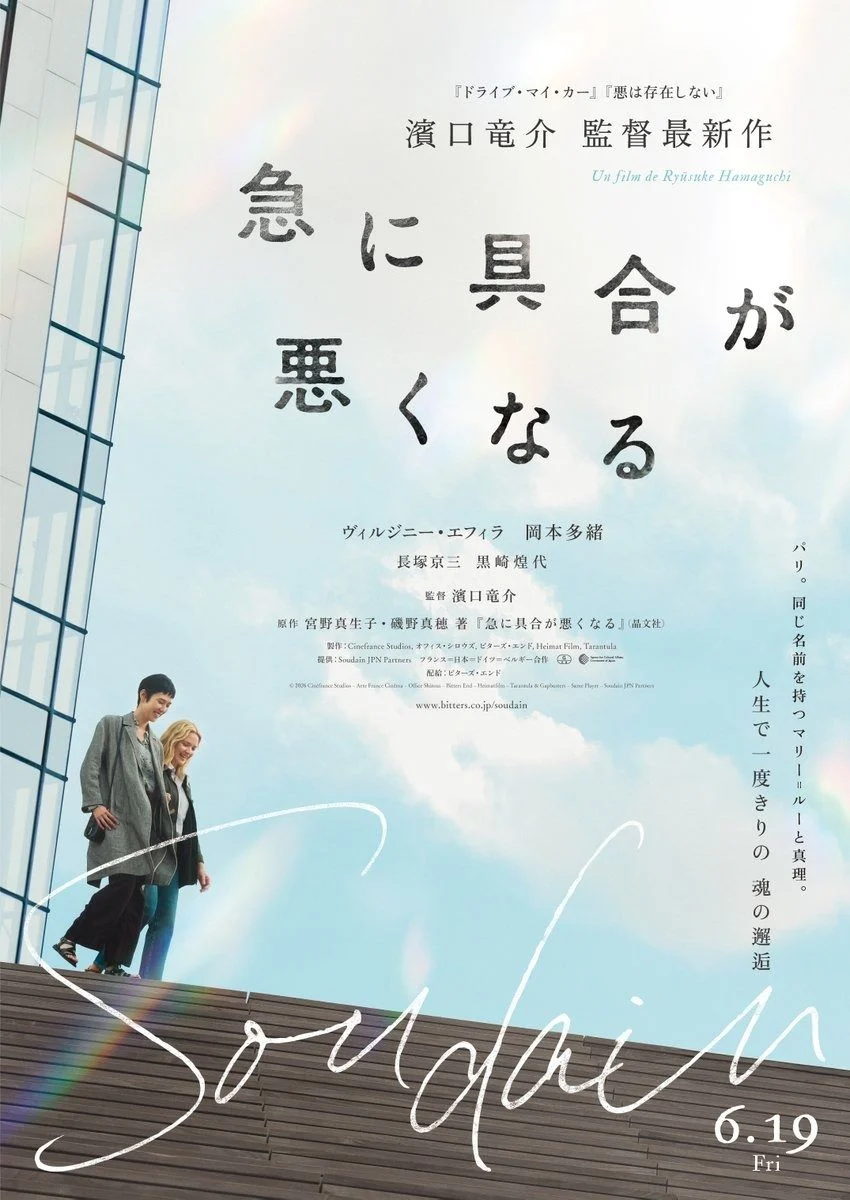
Coescrito por Ryusuke em colaboração com Léa Le Dimna, o roteiro é ambientado numa casa de repouso chamada Jardim da Liberdade, gerida por Marie-Lou (Efira), que, depois de ter perdido a mãe para o Alzheimer, decidiu abandonar a carreira anterior e dedicar a vida ao cuidado de outros com o mesmo zelo que gostaria que houvesse sido dedicado à mãe. Enfrentando resistência de alguns profissionais na clínica, especialmente da enfermeira-chefe Sophie (Bunel), que teme que o treinamento em humanidade possa reduzir o papel dos profissionais, Marie-Lou ainda precisa convencer o conselho de administradores da casa de repouso, mais interessado em maximizar o lucro, acolhendo mais residentes (maiores receitas) e congelando o salário dos profissionais (menores despesas). Neste contexto, Marie-Lou conhece a diretora de teatro Mari (Okamato), e rapidamente floresce uma amizade entre duas mulheres que não têm em comum somente os seus nomes, mas o propósito de transformar o mundo para melhor, nem que para isso precisem confrontar o sistema capitalista.
Se não é anticapitalista, All of a Sudden certamente reflete sobre como o sistema capitalista drena toda ou parte de nossa humanidade, a partir do conteúdo e da forma cinematográfica. Além de Marie-Lou precisar convencer o conselho da importância desse treinamento, que custará mais caro e exigirá profissionais mais qualificados do que o praticado em média nas casas de repouso, Mari literalmente expressa o pensamento do cineasta sobre o assunto. Enquanto reconhece as coisas boas que o sistema proporcionou, Ryusuke (através de Mari) é claro ao afirmar que o sistema só tem funcionado para um grupo reduzido de pessoas em um local que denomina Aqui e Agora – Nowhere, em inglês, o que carrega consigo a ironia. Além disso, o roteiro esclarece como o sistema plantou a semente de sua própria destruição enquanto esgota recursos externos, como a natureza, o tempo e o lazer das pessoas. Em uma exposição que é, simultaneamente, didática – o que envolve até um quadro branco – e narrativamente envolvente, é possível concluir que o anticapitalismo é pró-natureza e pró-humanidade, corroborando em parte a ação de Marie-Lou.
Antes de retornar a esse ponto, Ryusuke é igualmente anticapitalista em termos formais, começando pela duração da narrativa – 196 minutos -, avessa às práticas do mercado cinematográfico e ao déficit médio de atenção do espectador. Além disso, o tempo interno dos planos é igualmente alongado, com sequências que duram cinco, ou talvez até dez minutos, sem cortes. Após o reencontro, Marie-Lou e Mari caminham conversando sobre suas vidas e seus trabalhos e, enquanto compartilham experiências, memórias e perspectivas, o espectador também é convidado a conhecê-las melhor. Tudo isso em um extenso plano-sequência no qual as atrizes, Virginie Efira e Tao Okamato, alternam entre o francês e o japonês, enquanto uma rajada forte de vento – certamente não prevista pela direção – bagunça o penteado das atrizes e dificulta o trabalho de edição sonora.
Além disso, apesar de adicionar conflitos dramáticos suficientes – o câncer de Mari, a rivalidade entre Marie-Lou e Sophie ou a dificuldade de implementar a mudança que deseja -, Ryusuke, porém, não torna a narrativa refém de um cinema movido exclusivamente por conflitos, talvez o gesto mais anticapitalista que poderia adotar. Os personagens de sua narrativa são essencialmente bons, gentis e calorosos. Já aqueles que não se encaixam nessa categorização – os capitalistas – têm uma participação discreta o bastante para esquecermos que sequer estiveram presentes. E a maneira de processar os conflitos acontece através do olhar (a visibilidade), do toque (o abraço), da palavra (a comunicação) e, finalmente, da restituição da dignidade. Quer dizer, a partir de uma compreensão rigorosa de que deve praticar a teoria que prega, Ryusuke elabora uma narrativa que facilmente adere ao ideal defendido por Marie-Lou.
E entre os maiores gestos de humanidade está o reconhecimento da identidade dos homens e mulheres na casa de repouso, alguns deles já apenas com resquícios da experiência de tempo e memória. As imagens nos porta-retratos revelam a família que criaram e a profissão que exerceram, criando uma rima visual quando o rosto de Mari aparece refletido na janela. A dinâmica dela com Marie-Lou é emocionante na escuta e na presença (o Aqui e Agora em uma versão não capitalista, ou seja, a experiência genuína do momento), e culmina em um instante de raríssima beleza e sensibilidade em uma colina em Kyoto. Um momento em que o indivíduo é reconciliado com a natureza, o que, a propósito, fica evidente com os planos-detalhe dos pés descalços caminhando pelo jardim da casa de repouso e nas cinzas atiradas ao vento, que voam de volta à natureza.
A propósito, embora a morte esteja presente na experiência cotidiana do Jardim da Liberdade, a narrativa jamais transforma a mortalidade em um peso dramático. Pelo contrário, até estou surpreso com o quanto a narrativa é serena. Muito disso se deve às atuações de Efira e Okamato, mas também a Kyozo Nagatsuka e Marie Bunel, que apostam em atuações contidas, mas não resignadas; em silêncios espontâneos, e não planejados. Além do mais, o senso de humor, breve mas fundamental, atenua a temática, seja com a maneira divertida de Djibril, seja com a presença de espírito de Murano.
Além de confirmar Ryusuke Hamaguchi como um dos autores mais comunicativos e ternos do cinema contemporâneo, All of a Sudden é, por fim, um filme sobre a importância de cuidar daqueles que cuidam e de como isso atravessa, antes de mais nada, o ato anticapitalista e revolucionário de separar a vida do trabalho. Caso contrário, passaremos a ser engrenagens que apenas lembram vagamente o que era ser humano. Contrariamente ao que havia interpretado em um primeiro momento sobre a expressão “de perto ninguém é normal”, o filme não está se referindo ao indivíduo. Afinal de contas, a narrativa advoga que, de perto, somos capazes de reconhecer a humanidade no outro. É sobre o sistema. Quando colocamos a lupa sobre as nossas vidas, os nossos trabalhos ou as bases nas quais estamos inseridos, enxergamos o que de fato nos afasta de nossa humanidade.
O filme está na Seleção Oficial do Festival de Cannes de 2026.
English review
I had never imagined that watching people massage each other’s feet, sitting or lying on the grass of a nursing home beneath welcoming sunlight, could become the most comforting image I can remember seeing in cinema in quite some time. An experience that, incidentally, seems to suspend time itself, later controlled and manipulated with mastery by Japanese filmmaker Ryusuke Hamaguchi (of Evil Does Not Exist and the Oscar-winning Drive My Car) in this humanistic drama, All of a Sudden, or Soudain in French.
Co-written by Ryusuke alongside Léa Le Dimna, the screenplay is set in a nursing home called Garden of Freedom, managed by Marie-Lou (Efira), who, after losing her mother to Alzheimer’s disease, decided to abandon her previous career and dedicate her life to caring for others with the same devotion she wishes had been offered to her mother. Facing resistance from some professionals at the institution, especially head nurse Sophie (Bunel), who fears that training focused on humanity may diminish the professionals’ role, Marie-Lou must also convince the nursing home’s board of directors, far more interested in maximizing profit by admitting more residents (greater revenue) while freezing staff salaries (lower expenses). Within this context, Marie-Lou meets theater director Mari (Okamato), and a friendship quickly blossoms between two women who share not only their names, but also the desire to transform the world for the better, even if doing so requires confronting the capitalist system.
If it is not explicitly anti-capitalist, All of a Sudden certainly reflects upon how capitalism drains all or part of our humanity through both content and cinematic form. Beyond Marie-Lou’s struggle to convince the board of the importance of this training — one that would be more expensive and demand more qualified professionals than what is usually practiced in nursing homes — Mari literally voices the filmmaker’s perspective on the subject. While acknowledging the positive things the system has provided, Ryusuke (through Mari) makes it clear that the system has only truly worked for a reduced group of people in a place she calls Here and Now — “Nowhere” in English, an expression whose irony the film fully embraces. Furthermore, the screenplay demonstrates how the system has planted the seeds of its own destruction while exhausting external resources such as nature, time and people’s leisure. Through an exposition that is simultaneously didactic — even involving a whiteboard — and narratively engaging, it becomes possible to conclude that anti-capitalism is inherently pro-nature and pro-humanity, partially legitimizing Marie-Lou’s actions.
Before returning to that point, Ryusuke is equally anti-capitalist in formal terms, beginning with the narrative’s duration — 196 minutes — openly opposed to the practices of the cinematic marketplace and to the average viewer’s attention deficit. Beyond that, the internal duration of the shots is equally extended, with sequences lasting five, perhaps even ten uninterrupted minutes. After reuniting, Marie-Lou and Mari walk together discussing their lives and professions and, as they share experiences, memories and perspectives, the viewer is likewise invited to know them more intimately. All of this unfolds within an extensive long take in which actresses Virginie Efira and Tao Okamato alternate between French and Japanese, while a strong gust of wind — certainly unplanned by the director — dishevels their hair and complicates the sound editing process.
Moreover, although the film introduces enough dramatic conflicts — Mari’s cancer, the rivalry between Marie-Lou and Sophie, or the difficulty of implementing the changes she desires — Ryusuke nevertheless refuses to make the narrative hostage to a cinema driven exclusively by conflict, perhaps the most anti-capitalist gesture he could adopt. His characters are essentially kind, gentle and warm. Meanwhile, those who do not fit this categorization — the capitalists — appear discreetly enough that we almost forget they were ever present. And the film processes conflict through the gaze (visibility), touch (embrace), language (communication) and, ultimately, through the restoration of dignity. In other words, from a rigorous understanding that one must practice the theory one preaches, Ryusuke constructs a narrative that effortlessly adheres to the ideals defended by Marie-Lou herself.
Among the film’s greatest gestures of humanity lies the recognition of the identities of the men and women living in the nursing home, some of whom possess only fragments of memory and temporal awareness. The photographs in the picture frames reveal the families they built and the professions they once exercised, creating a visual rhyme when Mari’s face appears reflected in a window. Her dynamic with Marie-Lou becomes profoundly moving through listening and presence (the Here and Now in a non-capitalist form, that is, the genuine experience of the present moment), culminating in a moment of rare beauty and sensitivity atop a hill in Kyoto. A moment in which the individual is reconciled with nature, something that also becomes evident through the close-up shots of bare feet walking through the nursing home’s garden and the ashes thrown into the wind, returning to nature itself.
And although death is present throughout the everyday experience of the Garden of Freedom, the narrative never transforms mortality into a dramatic burden. On the contrary, I am actually surprised by how serene the film remains. Much of that comes from the performances by Efira and Okamato, but also from Kyozo Nagatsuka and Marie Bunel, who embrace restrained yet never resigned performances; spontaneous silences rather than carefully orchestrated ones. Furthermore, the film’s brief yet essential sense of humor softens the thematic weight, whether through Djibril’s amusing behavior or Murano’s remarkable wit.
Beyond confirming Ryusuke Hamaguchi as one of the most communicative and tender auteurs in contemporary cinema, All of a Sudden ultimately becomes a film about the importance of caring for those who care for others, and about how that responsibility necessarily passes through the anti-capitalist and revolutionary act of separating life from labor. Otherwise, we risk becoming mere gears that only vaguely remember what it once meant to be human. Contrary to what I initially interpreted from the expression “up close nobody is normal,” the film is not referring to the individual. After all, the narrative argues that, when observed closely, we are capable of recognizing humanity within one another. It is about the system itself. Once we place a magnifying glass over our lives, our jobs or the structures upon which we stand, we begin to recognize what truly distances us from our humanity.

Crítico de cinema filiado a Critics Choice Association, à Associação Brasileira de Críticos de Cinema, a Online Film Critics Society e a Fipresci. Atuou no júri da 39ª Mostra Internacional de Cinema em São Paulo/SP, do 12º Fest Aruana em João Pessoa/PB, do 24º Tallinn Black Nights Film na Estônia, do 47º TIFF – Festival Internacional de Cinema em Toronto. Ministrante do Laboratório de Crítica Cinematográfica na 1ª Mostra Internacional de Cinema em São Luís (MA) e Professor Convidado do Curso Técnico em Cinema do Instituto Estadual do Maranhão (IEMA), na disciplina Crítica Cinematográfica. Concluiu o curso de Filmmaking da New York Film Academy, no Rio de Janeiro (RJ) em 2013. Participou como co-autor dos livros 100 melhores filmes brasileiros (Letramento, 2016), Documentário brasileiro: 100 filmes essenciais (Letramento, 2017) e Animação Brasileira – 100 Filmes Essenciais (Letramento, 2018). Criou o Cinema com Crítica em fevereiro de 2010 e o Clube do Crítico em junho de 2020.