
Crítica em português
Ao imaginar um futuro próximo no qual empresas especializadas oferecem réplicas humanoides de pessoas falecidas para auxiliar famílias enlutadas a suportar a ausência, Black Mirror inevitavelmente surge como memória imediata. Só que seria injusto reduzir Sheep in the Box a uma derivação de um episódio da ficção especulativa da Netflix, porque o que interessa a Hirokazu Koreeda jamais esteve propriamente na tecnologia, mas na observação das fragilidades emocionais que atravessam indivíduos incapazes de elaborar perdas. Mesmo quando a encenação está ancorada em um futuro próximo de inteligências artificiais e crianças humanoides, o cineasta conserva os mesmos temas e sensibilidades que estruturam sua filmografia há décadas: famílias substitutas, relações pais e filhos, a infância e/ou a perspectiva infantil à vida.
Depois da morte trágica do filho, Kakeru, a arquiteta Otone mergulha no trabalho, como se a arquitetura pudesse recompor o seu mundo destruído. Seu projeto mais recente, a construção de uma casa no topo de uma colina íngreme, serve como um desafio em como projetar um espaço familiar em um território aparentemente irregular. O que soa como alegoria do processo de elaboração do luto e reconstrução da família após o acidente trágico.
É nesse vazio que aparece a empresa mencionada no capítulo introdutório, a Rebirth, uma continuidade artificial da existência. A recriação de Kakeru materializa o desejo contemporâneo de preencher o vazio do luto, com uma peça de um quebra cabeça que parece encaixar-se em razão da forma/aparência, embora o encaixe não seja o mesmo. E Koreeda, em vez de encarar esta possibilidade concreta com o terror tecnológico, parece fascinar-se com as suas possibilidades. Kakeru não é o que morreu apesar de manter algumas de suas memórias; mas um ser que, com o passar do tempo, revela deter sensibilidades particulares.
Assim, em vez de demonizar a inteligência artificial como uma ameaça à humanidade, Koreeda inverte o eixo tradicional dessa questão. E para além de perguntar se máquinas podem adquirir alguma forma de humanidade – pois, afinal, o seu cinema é humanista -, também se questiona se os humanos, hoje em dia, não enxergam as relações afetivas através de uma lógica de máquina, em que uma componente é capaz de ser substituída por outra componente defeituosa. Neste contexto, quando o líder de um grupo de adolescentes humanoides – e eu vou chegar lá – afirma que eles não representam o passado da humanidade, mas o seu futuro, o filme deixa de discutir só tecnologia e passa a flertar com temas existencialistas nunca completamente aprofundados.
De fato, há algo profundamente desconfortável na ideia de crianças (não importa se humanas ou humanoides) serem abandonadas após deixarem de satisfazer as expectativas emocionais dos pais. A tecnologia, portanto, não inova, mas amplifica o que já existe: a dificuldade de enfrentar frustrações afetivas limítrofes, tal como é o luto. Mas o roteiro de Sheep in the Box rapidamente se deteriora. Além do eco de O Senhor das Moscas, na qual uma figura adolescente mais velha – ou ao menos que aparenta sê-lo – de roupa inteiramente preta, mecha de cabelo grisalho e recém saído de um mangá pós-apocalíptico debate a tragédia da rejeição na tentativa de criar uma comunidade sua longe da humanidade, o filme ainda encontra nas influências mais óbvias em O Pequeno Príncipe uma mensagem que guie a percepção e o olhar do espectador sobre as ações de Kakeru.
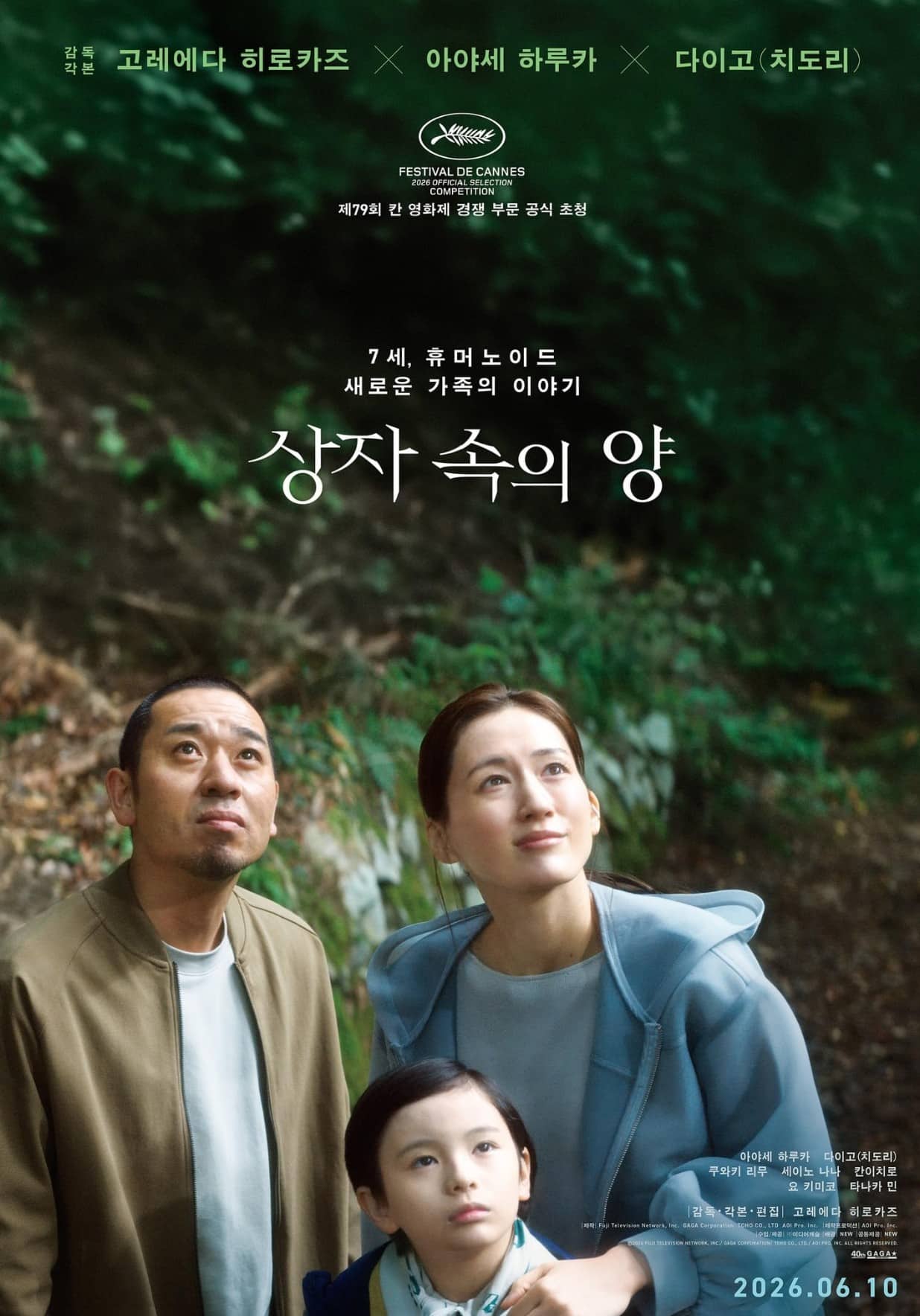
Formalmente, Sheep in the Box encontra alguns momentos sofisticados, embora está não seja exatamente a qualidade por que Koreeda é melhor lembrado. O esquema cromático utilizado distingue emocionalmente os personagens. Otone veste tons azulados e cinzentos, mais melancólicos e sugestivos da repressão emocional. Já os seus figurinos, diferente dos outros membros de sua família, tem um caráter mais futurista. Por sua vez, Kakeru surge constantemente associado ao amarelo, uma tonalidade solar e que confere uma humanidade oposta à artificialidade. E, em determinado instante, mãe e filho compartilham a mesma paleta cromática, ainda que em tonalidades distintas, como se a encenação promovesse a aproximação afetiva e, ato contínuo, a exclusão de Kensuke. Ele é, afinal, o mais cético e deslocado naquela dinâmica familiar reconstruída artificialmente.
Quando posiciona Otone atrás do banco utilizado para recarregar a bateria de Kakeru, Koreeda cria a imagem reveladora e que define sua mãe a partir de um dispositivo mecânico que a aprisiona, e essencial à manutenção da vida do filho substituto. Esses pequenos momentos me atraem bem mais porque apresentam questões emocionais sem recorrer a diálogos explicativos.
Contudo, com um roteiro fragmentado em múltiplos interesses, Koreeda não é capaz de se aprofundar em nenhum. A ideia do abandono e desaparecimento infantil respectivamente comunicada na criança abandonada sob o viaduto ou no cartaz estampado no interior de um aquário é desenvolvida apenas dentro do contexto Senhor das Moscas da narrativa. Já o luto individual, a maternidade e paternidade, que é o elemento central, se torna acessório à trajetória de autorrealização de Kakeru. Entretanto, a discussão sobre inteligência artificial como uma forma de consciência e sensibilidade permanece mal explorada. O fato de Kakeru absorver o talento arquitetônico e paisagístico da mãe sugere a possibilidade de criatividade (ou a emulação dela) em seres artificiais, mas o filme jamais dedica tempo para investigar suas (muitas) consequências. No lugar, uma imagem poética que tenta conectar humanidade, natureza e tecnologia que soa deslocada mesmo que bela.
Isso porque não mencionei algumas lacunas narrativas. Por exemplo, a ausência da informação do médico de que Kakeru removeu o seu dispositivo GPS parece só uma conveniência do roteiro.
Incapaz de oferecer as respostas às muitas perguntas (narrativas e filosóficas), Koreeda retorna ao básico, o de que o sofrimento humano jamais poderá ser resolvido por substituições artificiais, ainda que essas substituições consigam reproduzir afeto, sensibilidade e empatia. O vazio deixado pela morte de um ente querido não é preenchido pela presença de um Kakeru artificial, embora seja a sua presença que revele, negativamente, que a família precisará aprender a conviver com este vazio, em vez de negá-lo. A tecnologia pode recriar rostos e afetos, e em Sheep in the Box pode ir um passo adiante em dar-lhes humanidade e sensibilidade, mas o seu tema é tão ambicioso e plural que nem mesmo um mestre do cinema igual Koreeda é capaz de encará-lo plenamente.
Ao menos não nesse drama.
O filme está na Seleção Oficial do Festival de Cannes 2026.
English review
By imagining a near future in which specialized companies offer humanoid replicas of deceased individuals in order to help grieving families endure absence, Black Mirror inevitably comes to mind. Yet it would be unfair to reduce Sheep in the Box to a mere derivation of an episode from Netflix’s speculative fiction anthology, because what interests Hirokazu Kore-eda has never really been technology itself, but rather the observation of emotional fragilities that run through individuals incapable of processing loss. Even when the mise-en-scène is anchored in a near future populated by artificial intelligences and humanoid children, the filmmaker preserves the same themes and sensitivities that have structured his filmography for decades: surrogate families, parent-child relationships, childhood, and/or a child’s perspective on life.
After the tragic death of her son, Kakeru, the architect Otone throws herself into work, as though architecture itself could reconstruct her shattered world. Her latest project, the construction of a house atop a steep hill, functions as a challenge in how to design a familial space within seemingly irregular terrain. It feels like an allegory for the process of grieving and rebuilding a family after a devastating accident.
It is within this void that the company mentioned in the opening chapter, Rebirth, appears: an artificial continuation of existence. The recreation of Kakeru materializes the contemporary desire to fill the emptiness of grief with a puzzle piece that appears to fit because of its form and appearance, even if the fit is ultimately not the same. And Kore-eda, instead of confronting this possibility through technological horror, seems fascinated by its implications. Kakeru is not the one who died, despite retaining fragments of his memories, but rather a being who gradually reveals his own particular sensitivities over time.
Thus, rather than demonizing artificial intelligence as a threat to humanity, Kore-eda reverses the traditional axis of this discussion. Beyond asking whether machines can acquire some form of humanity — after all, his cinema is fundamentally humanist — the film also questions whether human beings today already perceive affective relationships through the logic of machinery, in which one component can simply be replaced by another defective component. In this context, when the leader of a group of humanoid teenagers — and I will get to that — states that they do not represent humanity’s past, but its future, the film ceases to be solely about technology and begins flirting with existentialist themes it never fully develops.
Indeed, there is something profoundly unsettling about the idea of children (whether human or humanoid) being abandoned once they no longer satisfy the emotional expectations of their parents. Technology, therefore, does not innovate so much as amplify what already exists: the difficulty of confronting emotional frustrations at the limits of human experience, such as grief itself. But the screenplay of Sheep in the Box rapidly deteriorates. Beyond the echoes of Lord of the Flies — in which an older adolescent figure, or at least one who appears older, dressed entirely in black, with a streak of gray hair and looking as though he stepped out of a post-apocalyptic manga, debates the tragedy of rejection while attempting to create his own community away from humanity — the film also turns toward the more obvious influences of The Little Prince in search of a guiding message for how the viewer should perceive Kakeru’s actions.
Formally, Sheep in the Box finds several sophisticated moments, even though sophistication of form is not necessarily the quality for which Kore-eda is most remembered. The chromatic scheme emotionally distinguishes the characters. Otone dresses in bluish and gray tones, more melancholic and suggestive of emotional repression. Her wardrobe, unlike that of the other members of her family, also carries a more futuristic quality. Kakeru, meanwhile, is constantly associated with yellow, a solar tone that grants him a humanity opposed to artificiality. And, at a certain moment, mother and son share the same chromatic palette, albeit in distinct tonalities, as though the mise-en-scène itself were promoting their emotional rapprochement while simultaneously excluding Kensuke. After all, he is the most skeptical and displaced figure within that artificially reconstructed family dynamic.
When Kore-eda positions Otone behind the station used to recharge Kakeru’s battery, he creates a revealing image that defines the mother through a mechanical device that imprisons her while simultaneously remaining essential to sustaining the life of her substitute child. These small moments interest me far more because they present emotional questions without resorting to explanatory dialogue.
However, with a screenplay fragmented across multiple interests, Kore-eda is unable to fully deepen any of them. The idea of abandonment and childhood disappearance, respectively communicated through the abandoned child beneath the overpass or the missing-person poster displayed inside the aquarium, is developed only within the narrative’s Lord of the Flies framework. Meanwhile, individual grief, motherhood, and fatherhood — which should constitute the emotional core — become secondary to Kakeru’s trajectory of self-realization. Yet the discussion surrounding artificial intelligence as a form of consciousness and sensitivity remains underexplored. The fact that Kakeru absorbs his mother’s architectural and landscaping talents suggests the possibility of creativity (or the emulation of it) within artificial beings, but the film never devotes enough time to investigating its many consequences. Instead, it settles for a poetic image attempting to connect humanity, nature, and technology, one that feels strangely displaced even while undeniably beautiful.
That is without even mentioning certain narrative gaps. For instance, the doctor’s failure to inform the family that Kakeru had removed his GPS device feels less like character logic than a mere screenplay convenience.
Unable to provide answers to its many narrative and philosophical questions, Kore-eda ultimately returns to basics: the idea that human suffering can never truly be resolved through artificial substitutions, even when those substitutions are capable of reproducing affection, sensitivity, and empathy. The void left by the death of a loved one cannot be filled by the presence of an artificial Kakeru, even if it is precisely his presence that negatively reveals how the family must learn to coexist with that emptiness rather than deny it. Technology may recreate faces and affections, and in Sheep in the Box it may even go one step further by granting them humanity and sensitivity, but the film’s themes are so ambitious and plural that not even a cinematic master like Kore-eda can fully confront them.
At least not within this drama.

Crítico de cinema filiado a Critics Choice Association, à Associação Brasileira de Críticos de Cinema, a Online Film Critics Society e a Fipresci. Atuou no júri da 39ª Mostra Internacional de Cinema em São Paulo/SP, do 12º Fest Aruana em João Pessoa/PB, do 24º Tallinn Black Nights Film na Estônia, do 47º TIFF – Festival Internacional de Cinema em Toronto. Ministrante do Laboratório de Crítica Cinematográfica na 1ª Mostra Internacional de Cinema em São Luís (MA) e Professor Convidado do Curso Técnico em Cinema do Instituto Estadual do Maranhão (IEMA), na disciplina Crítica Cinematográfica. Concluiu o curso de Filmmaking da New York Film Academy, no Rio de Janeiro (RJ) em 2013. Participou como co-autor dos livros 100 melhores filmes brasileiros (Letramento, 2016), Documentário brasileiro: 100 filmes essenciais (Letramento, 2017) e Animação Brasileira – 100 Filmes Essenciais (Letramento, 2018). Criou o Cinema com Crítica em fevereiro de 2010 e o Clube do Crítico em junho de 2020.