

Artigo em português
O Festival de Annecy é o maior festival do cinema de animação, e tive a oportunidade de conferir, com exclusividade, Julián e Chimney Town. Abaixo, o que achei sobre os filmes e o convite para que conheçam em breve.
Julian
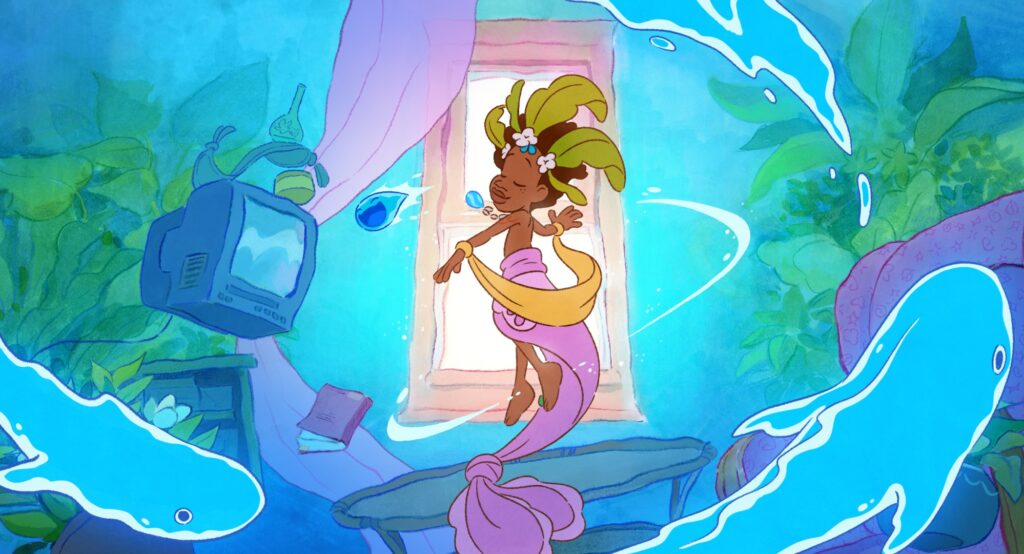
A fantasia é o terreno onde o cinema deposita muito daquilo que a realidade ainda não consegue acomodar. Em Julian, porém, a fantasia não é o refúgio do real. É simplesmente o olhar de uma criança ao mundo ao seu redor. Julián é um garoto descendente de dominicanos que deseja ser uma sereia. O seu desejo não é tratado como uma extravagância, nem como uma metáfora excessivamente calculada. Para Julián e os seus familiares, trata-se somente de uma possibilidade tão concreta quanto qualquer outro sonho infantil. É essa naturalidade que torna a animação tão delicada.
O roteiro recusa na maior parte do tempo o caminho mais óbvio do conflito. Em vez de transformar os adultos em figuras planas, constrói relações atravessadas pelo afeto, ainda quando marcadas pela incompreensão. O pai não procura corrigir o filho, aí enfrentando de frente o estereótipo do macho latino-americano. O papel dele é proteger o filho sem limitar a sua imaginação, oferecendo um acolhimento que, raramente, encontra espaço em narrativas destinadas ao público infantil em que o protagonista é lido como queer.
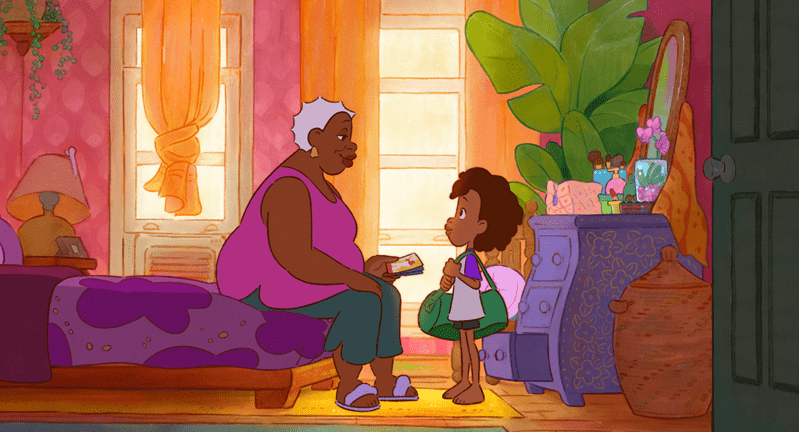
A avó ocupa um lugar mais complexo. Ela carrega consigo as tradições da família dominicana e uma visão de mundo moldada por uma outra geração. Inicialmente, torna-se um obstáculo para Julián não por falta de amor, mas porque não consegue enxergá-lo por inteiro. Por algum tempo, o afeto e o preconceito coexistem nessa relação. A tentativa de aproximação entre as gerações exige o olhar sensível, mais do que o confronto; a escuta, mais do que a imposição. A transformação dessa relação interessa mais ao longa do que a tentativa rasa de diferenciar heróis e vilões.
Essa delicadeza aparece na linguagem visual. O trio de diretores Louise Bagnall, Guillaume Lorin e Mark Mullery constroem uma animação de cores vibrantes que responde diretamente ao estado emocional de Julian. A exuberância acompanha um menino expansivo, curioso e sorridente, alguém para quem um aquário, um colar, a chuva de verão ou um reflexo podem desencadear um universo de possibilidades.
Já fantasia não rompe completamente com o cotidiano. O filme permanece ancorado na comunidade dominicana do Brooklyn, valoriza a sua música, sua culinária, seus rituais e a convivência entre vizinhos. Essa raiz na realidade impede que a imaginação seja só escapismo. O extraordinário nasce da relação de Julián consigo mesmo diante das experiências do dia a dia. A criança ainda é capaz de encontrar magia onde os adultos já enxergam cotidiano.
A alegria da animação não significa a falta do reconhecimento de que há instantes de dor. Julian cresce ouvindo comentários que tentam diminuí-lo, experimenta a ofensa homofóbica de alguns pré-adolescentes. Em nenhum momento, a animação reduz o seu protagonista a uma bandeira ou a um panfleto. Antes de qualquer debate sobre identidade ou expressão de gênero, Julian continua sendo uma criança, e uma criança que sonha. Faz perguntas inconvenientes, emburra com a comida da avó, inventa mentiras, transforma acontecimentos em aventuras. A infância é infância e não instrumento para um filme de mensagem, e talvez isso seja o melhor.
De todo modo, é provável que parte do público leia sua proposta exclusivamente através do filtro das disputas culturais contemporâneas. No entanto, essa é uma leitura que a narrativa não pretende encenar. Julián exercita a capacidade de olhar uma criança, antes de projetar sobre ela expectativas, medos ou convenções. Claro, é difícil não imaginar que Julian encontrará o seu público-alvo mais importante entre os que cresceram acreditando que seus sonhos precisavam ser escondidos (no armário) para caber dentro das expectativas dos outros.
Contudo, não só meninos que sonham ser sereias, mas qualquer criança que um dia tenha ouvido ser diferente é o público-alvo de um filme que ainda dialoga com as famílias. Afinal, a imaginação não existe para substituir a realidade. Mas para ampliá-la e questioná-la.
Chimney Town
Não tendo assistido ao primeiro Chimney Town, a minha experiência com esta continuação acabou sendo particular mesmo que o roteiro pareça oferecer informações bastantes para que novos espectadores acompanhem a aventura de Lubicchi, um habitante da Cidade das Chaminés do título, em um mundo fantástico para restaurar o mecanismo de um relógio e fazê-lo voltar a funcionar.
O aspecto mais impressionante da animação, no entanto, está longe de sua aventura. Está em seu universo criativo e imagético, composto por um conjunto de cenários extraordinários. A Cidade das Chaminés é uma metrópole industrial permanentemente envolta por fumaça, cujas ruas estreitas, construções verticais e perspectiva acentuada evocam até certo ponto o imaginário expressionista. É um espaço que transmite encantamento e opressão ao mesmo tempo, refletindo personagens incapazes de seguir adiante.
Quando a narrativa abandona esse ambiente e conduz Lubicchi ao reino fantástico onde repousa o relógio, a direção amplia o imaginário visual: paisagens luminosas, criaturas fantásticas e construções que parecem desafiar a lógica compõem um espetáculo de enorme riqueza e deslumbramento. Há um cuidado em transformar cada cenário em algo digno de contemplação, sem perder a fluidez da animação nem a sensação de descoberta, o que a direção não consegue o tempo inteiro.
O relógio parado às 11h59 funciona como a imagem para os personagens incapazes de seguir em frente depois de uma perda, um tema martelado repetidas vezes. Tanto Lubicchi quanto Gus compartilham a experiência do luto. Ambos vivem presos à memória de pessoas (e pessoas) queridas e precisam compreender que permanecer imóvel não é uma opção. Aliás, o fato de uma personagem ser uma árvore é um reforço à ideia de seguir em frente. Não a partir do esquecimento do passado. Mas do reconhecimento das lembranças e dos objetos que carregam a saudade daqueles que partiram.
Contudo, eu tenho algumas ressalvas com a estrutura da narrativa. Em determinado momento, o roteiro abandona temporariamente o seu conflito central para desenvolver uma narrativa paralela cuja importância só se revela mais adiante. A conexão entre as duas linhas existe e é relativamente coerente dentro da resolução proposta, mas a transição provoca uma dispersão que é perigosa para a narrativa. Talvez um desenvolvimento alternado entre os dois núcleos… embora não seja o meu papel refazer o filme feito pelo diretor.
Ainda assim, Chimney Town permanece como uma animação com uma inventividade estética e de rara sensibilidade ao abordar um tema tão complexo quanto o luto para o público infantil. Em vez de oferecer respostas fáceis, ou mesmo respostas, opta por lembrar que seguir adiante não significa abandonar quem amamos. Mas permitir que essas lembranças deixem de paralisar o tempo presente.

English article
Annecy is the world’s leading animation film festival, and I had the opportunity to watch Julián and Chimney Town exclusively. Here are my thoughts on both films—and why they deserve your attention when they become available.
Julián
Fantasy is often the place where cinema stores everything reality still struggles to embrace. In Julián, however, fantasy is not an escape from reality. It is simply the way a child sees the world around him.
Julián is a Dominican-American boy who dreams of becoming a mermaid. His wish is never treated as an oddity or as an overdetermined metaphor. For Julián—and, to varying degrees, for his family—it is simply as valid and tangible as any other childhood dream. That sense of normalcy is precisely what makes the film so delicate.
For most of its running time, the screenplay avoids the most obvious dramatic path. Rather than reducing its adults to one-dimensional figures, it builds relationships shaped by affection, even when they are marked by misunderstanding. Julián’s father never tries to “fix” his son, directly challenging the stereotype of the hyper-masculine Latin American father. His role is to protect Julián without limiting his imagination, offering a kind of unconditional support that is still remarkably rare in children’s films featuring a queer-coded protagonist.
His grandmother occupies a far more complex position. She carries the traditions of her Dominican family and a worldview shaped by an older generation. Initially, she becomes an obstacle not because she lacks love for her grandson, but because she cannot yet see him in his entirety. For a time, affection and prejudice coexist within their relationship. The film suggests that bridging this generational divide requires empathy rather than confrontation, listening rather than imposing. That evolving relationship ultimately matters far more than drawing simplistic lines between heroes and villains.
The same sensitivity is reflected in the film’s visual language. Directors Louise Bagnall, Guillaume Lorin, and Mark Mullery create a vibrant palette that mirrors Julián’s emotional world. The richness of the colors follows an exuberant, curious, joyful child—someone for whom an aquarium, a necklace, a summer rainstorm, or a reflection can open an entire universe of possibilities.
Yet fantasy never completely breaks away from everyday life. The story remains firmly rooted in Brooklyn’s Dominican community, celebrating its music, food, traditions, and neighborhood life. This grounding prevents imagination from becoming mere escapism. Instead, the extraordinary emerges naturally from Julián’s relationship with himself and the ordinary experiences that surround him. Children still possess the ability to find magic where adults see only routine.
The film’s joyful tone does not ignore pain. Julián grows up hearing comments meant to diminish him and experiences homophobic bullying from older boys. Yet the film never reduces him to a symbol or a political statement. Before any conversation about identity or gender expression, Julián is simply a child—a child who dreams. He asks uncomfortable questions, refuses his grandmother’s cooking, tells little lies, and transforms ordinary moments into adventures. Childhood remains childhood, rather than becoming a vehicle for a message, and that may be the film’s greatest achievement.
Of course, some viewers will inevitably interpret the film exclusively through the lens of today’s culture wars. Yet that is not the story the film is interested in telling. Julián invites us to see a child before projecting onto him our expectations, fears, or inherited conventions.
It is easy to imagine that the film’s most important audience will be those who grew up believing their dreams had to remain hidden in order to fit other people’s expectations. But Julián speaks not only to boys who dream of becoming mermaids. It speaks to every child who has ever been told they were different, while also reaching out to the families around them.
After all, imagination does not exist to replace reality. It exists to expand it—and to question it.
Chimney Town
Having never seen the original Chimney Town, my experience with this sequel was inevitably a unique one, even though the screenplay provides enough context for newcomers to follow Lubicchi’s journey. A resident of Chimney Town, he ventures into a fantastical realm to restore a mysterious clock and set time in motion once again.
The film’s greatest strength, however, lies not in its adventure but in its extraordinary visual imagination. Chimney Town itself is a remarkable creation: an industrial metropolis permanently shrouded in smoke, with narrow streets, towering architecture, and exaggerated perspectives that evoke the imagery of German Expressionism. It is a place that feels simultaneously enchanting and oppressive, reflecting characters who have become incapable of moving forward.
Once the story leaves the city behind and enters the magical kingdom where the stopped clock rests, the visual ambition expands even further. Luminous landscapes, fantastical creatures, and architecture that seems to defy logic create images of remarkable richness and wonder. Every setting is designed to invite contemplation without sacrificing the fluidity of the animation or the constant sense of discovery—although the direction does not always sustain that balance throughout the film.
The clock forever frozen at 11:59 becomes a powerful metaphor for characters unable to move beyond loss, a theme the film returns to repeatedly. Both Lubicchi and Gus share the experience of grief. They remain attached to the memory of loved ones and must eventually understand that standing still is no way to honor them. Even the fact that one of the central characters is a tree reinforces the idea of growth and perseverance. The film never argues for forgetting the past. Instead, it values memory and the objects that preserve the presence of those who are gone, while reminding us that remembrance should not imprison the living.
My main reservation concerns the film’s narrative structure. At one point, the screenplay temporarily abandons its central conflict to focus on a secondary storyline whose relevance becomes clear only later. The connection between both narrative threads ultimately makes sense, but the transition creates a sense of fragmentation that weakens the pacing. Perhaps alternating between the two storylines more consistently would have resulted in a smoother dramatic progression—although rewriting the film is hardly the critic’s role.
Even so, Chimney Town remains an animation of remarkable visual inventiveness and uncommon sensitivity in the way it approaches grief for young audiences. Rather than offering easy answers—or even answers at all—it simply reminds us that moving forward does not mean leaving our loved ones behind. It means allowing their memory to stop freezing the present, so that life itself can begin to move again.


Crítico de cinema filiado a Critics Choice Association, à Associação Brasileira de Críticos de Cinema, a Online Film Critics Society e a Fipresci. Atuou no júri da 39ª Mostra Internacional de Cinema em São Paulo/SP, do 12º Fest Aruana em João Pessoa/PB, do 24º Tallinn Black Nights Film na Estônia, do 47º TIFF – Festival Internacional de Cinema em Toronto. Ministrante do Laboratório de Crítica Cinematográfica na 1ª Mostra Internacional de Cinema em São Luís (MA) e Professor Convidado do Curso Técnico em Cinema do Instituto Estadual do Maranhão (IEMA), na disciplina Crítica Cinematográfica. Concluiu o curso de Filmmaking da New York Film Academy, no Rio de Janeiro (RJ) em 2013. Participou como co-autor dos livros 100 melhores filmes brasileiros (Letramento, 2016), Documentário brasileiro: 100 filmes essenciais (Letramento, 2017) e Animação Brasileira – 100 Filmes Essenciais (Letramento, 2018). Criou o Cinema com Crítica em fevereiro de 2010 e o Clube do Crítico em junho de 2020.