
Crítica em português
Desde sua estreia na direção com Fora de Série (Booksmart), Olivia Wilde demonstra interesse por personagens aprisionados por expectativas sociais e afetivas. Se o olhar feminino guiava o coming of age adolescente de seu primeiro longa e a crítica ao patriarcado conduzia o thriller psicológico Não Se Preocupe, Querida (Don’t Worry Darling), em O Convite (The Invite) esses temas reaparecem sob uma perspectiva mais cotidiana. Entre a comédia e o drama, Wilde transforma um jantar entre vizinhos em uma investigação das frustrações, desejos e ressentimentos que habitam a vida a dois.
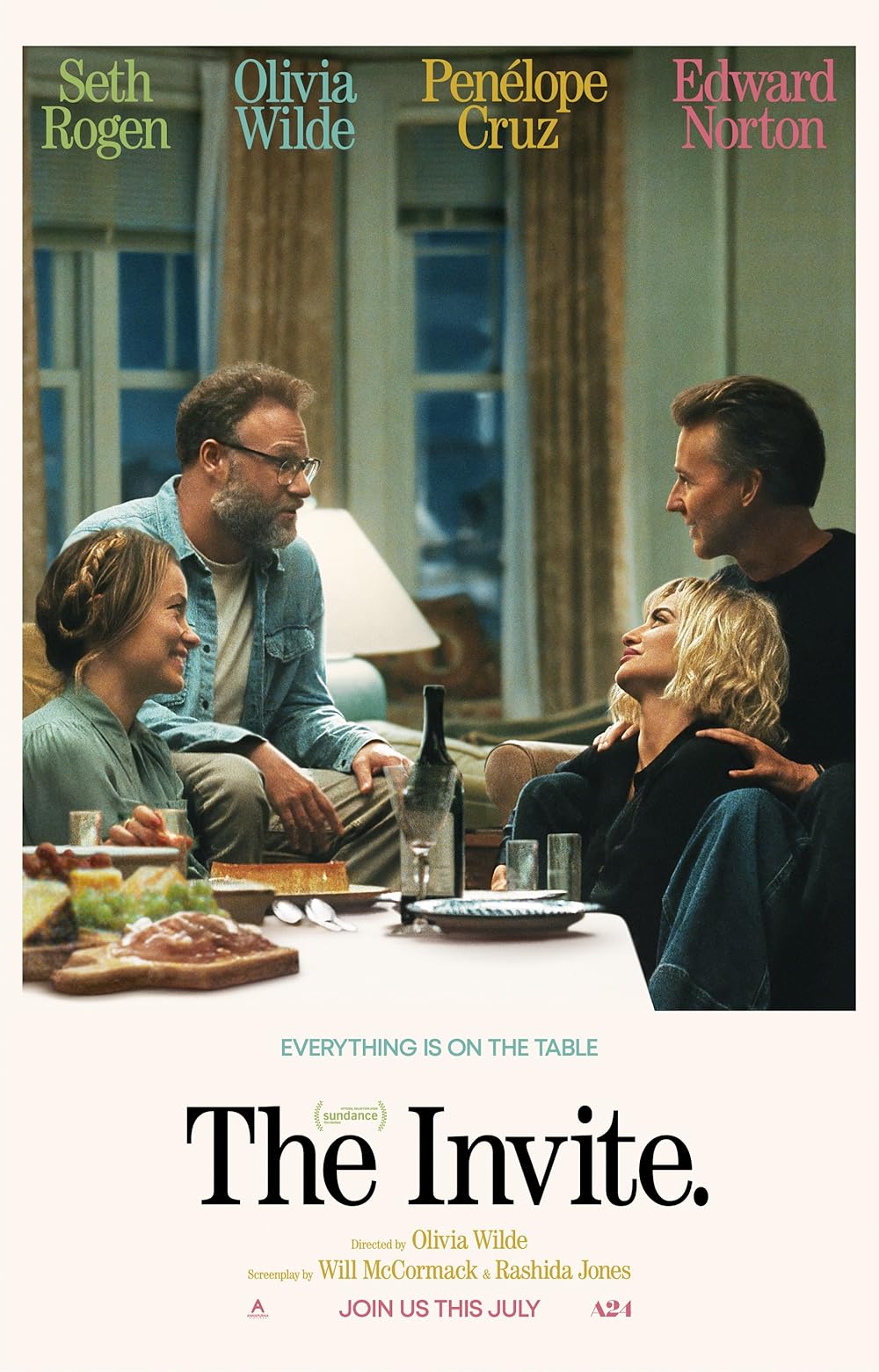
Antes de mais nada, antecipo que acredito ser impossível qualquer pessoa que faça parte de um casal não sentir medo do fantasma da rotina, das expectativas e frustrações ou até mesmo das coisas não ditas — e falo isso do lugar de quem tem pouco menos de três anos de relação sob o mesmo teto. Assim como também acredito ser impossível não se enxergar, seja por experiência própria ou por autocrítica, dentro das situações colocadas pelo filme. O Convite mostra os conflitos do casal Joe (Seth Rogen) e Angela (Olivia Wilde), que se estendem desde o anúncio do jantar com os vizinhos sedutores e bem relacionados, Hawk (Edward Norton) e Pina (Penélope Cruz), para além da chegada dos convidados. Entre acusações, flertes, mágoas represadas e faíscas, todas as emoções escalonam a cada interação.
O diálogo ácido e ágil do filme é um dos seus grandes acertos por conseguir ditar o ritmo da narrativa, apesar de ela se passar a maior parte do tempo dentro dos limites do apartamento. Nesse sentido, O Convite remete às comédias malucas (screwball comedies) da Hollywood clássica, como Jejum do Amor (His Girl Friday) e Núpcias de um Escândalo (The Philadelphia Story) — ambas com Cary Grant. Por ser também um filme de câmara — adaptado de Sentimental, produção espanhola derivada da peça Los vecinos de arriba, ambas dirigidas por Cesc Gay —, o filme também me traz à memória Quem Tem Medo de Virginia Woolf? (Who’s Afraid of Virginia Woolf?) e Deus da Carnificina (Carnage). Novamente, vemos uma história com poucos personagens, na qual um apartamento se torna uma cápsula claustrofóbica incapaz de conter a tensão.
Olivia Wilde é certeira ao utilizar o apartamento de Joe e Angela como um personagem vivo, que conta a história daqueles dois. Os testes de pintura revelam tentativas de ser notada ao mesmo tempo em que camuflam Angela nos tons melancólicos de azul; o escritório de Joe acolhe sua ranzinzice e aprisiona suas frustrações. Até mesmo a observação aparentemente despretensiosa de que aquele imóvel já abrigou dois apartamentos separados por uma única divisória soa deliberada dentro da trama. Mas a grande genialidade está na forma como o espaço é explorado para denunciar o isolamento do casal. São cômodos que permitem observar o outro à distância, como se estivessem em lados opostos. A maneira como a câmera atravessa as paredes na cena final é pura poesia cinematográfica.
A mise-en-scène pensada por Wilde revela a riqueza de seu repertório e a potência autoconsciente de sua direção — e isso pode ser notado desde a abertura, com a montagem dos créditos iniciais que denuncia o descompasso entre o casal e antecipa o clima dos eventos a seguir. A diretora brinca com a câmera quando explora um ângulo baixo e a luz de um abajur para “monstrificar” Joe antes de uma fala acusatória, ou cerca o casal de anfitriões em uma dinâmica predador-presa antes de uma proposta mais ousada. Até a dinâmica entre os dois casais é definida por seu posicionamento diante da câmera e pela distância entre eles dentro do quadro. No mais, texturas, cores, tensão e tesão também compõem visualmente o filme. Se os anfitriões usam roupas despojadas em tons azulados e cáqui para expressar a distância temporal de sua última transa — afinal, nada mais sexualmente desestimulante do que bege —, os convidados trazem decote e sofisticação em um figurino preto que esconde segundas intenções.
Mas O Convite discute relacionamentos de maneira descontraída, na medida certa. Apesar das discussões em forma de conversa fiada que escalonam a cada frase dita, a tensão também é liberada através do riso. Mas é principalmente por meio da comédia que a relação da diretora com os temas que lhe são caros — crítica ao patriarcado, sororidade e quebra de tabus sociais — se fortalece. O roteiro assinado por Rashida Jones e Will McCormack traz cenas que ora ridicularizam as figuras masculinas, ora revelam suas vulnerabilidades. Nesse sentido, consegue subverter o mansplaining e o manterrupting sem soar panfletário, como quando Pina não admite ter seu domínio da língua inglesa questionado ou quando um homem vê sua fala interrompida por um flan. A escolha do elenco também é certeira. Penélope Cruz e a própria Olivia Wilde são atrizes que carregam consigo uma intensidade natural, enquanto Norton e Rogen trazem uma fragilidade intrínseca, quase infantil. O grande acerto do filme está em revelar feridas sem buscar apontar dedos, reconhecendo erros em ambas as partes. E, principalmente, em escancarar que a distância mais difícil a ser percorrida é entre duas pessoas.
English Review
Since making her directorial debut with Booksmart, Olivia Wilde has shown a keen interest in characters trapped by social and emotional expectations. While the female gaze guided the coming-of-age story of her first feature and a critique of patriarchy drove the psychological thriller Don’t Worry Darling, in The Invite these themes reappear from a more everyday perspective. Balancing comedy and drama, Wilde turns a dinner party between neighbors into an investigation of the frustrations, desires, and resentments that inhabit life as a couple.
Before anything else, I should admit that I believe it is impossible for anyone in a relationship not to fear the specter of routine, expectations, frustrations, or even the things left unsaid—and I say this as someone who has shared a home with a partner for just under three years. Likewise, I believe it is impossible not to see oneself, whether through personal experience or self-reflection, in the situations presented by the film. The Invite follows the conflicts between Joe (Seth Rogen) and Angela (Olivia Wilde), which begin with the announcement of a dinner party involving their seductive and well-connected neighbors, Hawk (Edward Norton) and Pina (Penélope Cruz), and continue long after the guests arrive. Between accusations, flirtation, bottled-up grievances, and sparks of attraction, every emotion escalates with each interaction.
The film’s sharp and acidic dialogue is one of its greatest strengths, dictating the pace of the narrative despite most of the action taking place within the confines of a single apartment. In this sense, The Invite recalls the screwball comedies of Classical Hollywood, such as His Girl Friday and The Philadelphia Story—both starring Cary Grant. As a chamber piece adapted from the Spanish film Sentimental, itself based on the stage play The People Upstairs (Los vecinos de arriba), both directed by Cesc Gay, it also brings to mind Who’s Afraid of Virginia Woolf? and Carnage. Once again, we are presented with a story involving only a handful of characters, in which an apartment becomes a claustrophobic capsule incapable of containing the mounting tension.
Wilde is remarkably precise in turning Joe and Angela’s apartment into a living character, one that tells the story of their relationship. The paint samples scattered across the walls reveal attempts to be noticed while simultaneously camouflaging Angela within melancholic shades of blue; Joe’s office embraces his grumpiness while imprisoning his frustrations. Even the seemingly casual remark that the property once housed two separate apartments divided by a single wall feels deliberately woven into the narrative. Yet the film’s greatest stroke of genius lies in the way the space is used to expose the couple’s isolation. These are rooms that allow one partner to observe the other from afar, as though they occupied opposite sides of an invisible divide. The way the camera moves through walls in the final scene is pure cinematic poetry.
The mise-en-scène conceived by Wilde reveals both the richness of her cinematic vocabulary and the self-awareness of her direction. This is evident from the opening credits sequence, whose editing establishes the couple’s emotional disconnect and foreshadows the tensions to come. Wilde plays with the camera by using a low angle and the light from a lamp to “monstrify” Joe before an accusatory remark, or by framing the hosting couple within a predator-prey dynamic before a particularly bold proposition. Even the relationship between the two couples is defined by their positioning before the camera and the physical distance separating them within the frame. Textures, colors, tension, and desire also shape the film visually. While the hosts wear casual outfits in shades of blue and khaki to suggest how long it has been since they last had sex—after all, nothing is quite as sexually uninspiring as beige—the guests arrive draped in black, exuding sophistication and concealed intentions.
Yet The Invite approaches relationships with just the right amount of levity. Although the arguments masquerade as casual conversation and escalate with every sentence spoken, tension is also released through laughter. More importantly, it is through comedy that Wilde’s engagement with the themes closest to her heart—critiques of patriarchy, female solidarity, and the breaking of social taboos—becomes most apparent. The screenplay by Rashida Jones and Will McCormack presents scenes that either ridicule male figures or expose their vulnerabilities. In doing so, it subverts mansplaining and manterrupting without ever becoming preachy, whether through Pina’s refusal to let her command of the English language be questioned or through the sight of a man having his speech interrupted by a flan. The casting is equally inspired. Penélope Cruz and Olivia Wilde possess a natural intensity, while Norton and Rogen bring an almost childlike fragility to their performances. The film’s greatest achievement lies in exposing emotional wounds without seeking to assign blame, acknowledging the mistakes made by both sides. Above all, it reminds us that the most difficult distance to cross is the one between two people.

JORNALISTA, PUBLICITÁRIO E CRÍTICO DE CINEMA. Cresceu no ambiente da videolocadora de bairro, onde teve seu primeiro emprego. Ávido colecionador de mídia física, reune mais de 3 mil títulos na sua coleção. Já participou de produções audiovisuais independentes, na captura de som e na produção de trilha musical. Hoje, escreve críticas de filmes pro site do Cinema com Crítica e é responsável pela editoração das apostilas do Clube do Crítico. Em 2025, criou seu perfil, Cria de Locadora, para comentar cinema em diversos formatos.