
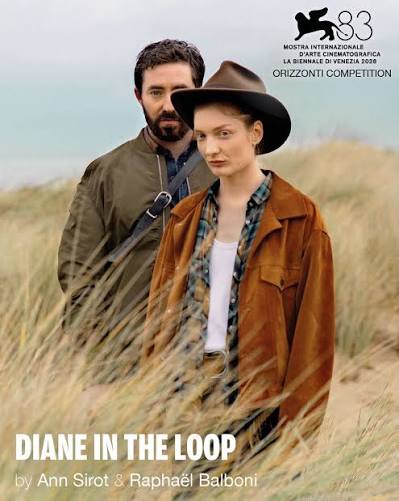
O faroeste nasceu como o gênero de histórias sobre homens colonizadores e desbravadores, que atravessaram extensões de terra do velho oeste, com a arma na cintura, na maioria dos casos para restaurar a ordem que havia sido perdida, o equivalente à reconquistar uma civilização perdida. Quando Ann Sirot e Raphaël Balboni levam esse imaginário para Diane in the Loop, a intenção parece ser de complicar essa fórmula, porque o modo de se vestir, de se comportar ou até alguns enquadramentos não transformam a personagem-título em uma heroína de faroeste clássico e nem conferem a dimensão épica à batalha enfrentada por ela, ainda que proporcionem o duelo simbólico entre formas de lidar com a violência. Diane quer lembrar e punir; a Mãe, deseja manter escondido o que determinou sua vida pelos 30 anos passados. É deste duelo que surge o melhor e o pior de uma narrativa original e inventiva.
Aos 28 anos, Diane (Borsei) parece não saber muito bem para onde está indo a sua vida. A prisão, onde acabou passando uma noite após ser detida por agredir um homem, funciona como uma espécie de estopim. Depois de a Mãe (Blancke) buscá-la na delegacia e enfurecida com as escolhas da vida da filha, acaba revelando uma informação guardada por décadas: aos 19 anos, foi estuprada por um homem morto após ser atingido por um raio. A descoberta provoca uma alteração na maneira com que Diane percebe a vida de sua mãe e suas decisões, e a impele em uma jornada cheia de acasos, acidentes e coincidências para tentar encontrar uma forma de satisfação de seu desejo por justiça.
No roteiro, um acidente provoca outro, uma decisão desencadeia uma consequência inesperada, um encontro retira da inércia alguém que parecia ter parado no tempo. A mãe volta à universidade e, no estágio, reencontra a melhor amiga (Ayadi), que é mais do que só a melhor amiga; Diane pega emprestado o carro do pai, oferece carona para um homem (Meister), com quem se relaciona e que pode ter uma relação indireta com o caso. Diane in the Loop tem uma estrutura assumidamente de fábula, especialmente com a morte prosaica do agressor.
Isso não é impeditivo para Diane buscar justiça, porque o estupro que descarrilhou a vida da Mãe, e por consequência a sua, continua ocupando espaços. O trauma é herdado por Diane, que precisa encerrar o ciclo à sua maneira, mesmo que a Mãe já tenha recomeçado a trajetória interrompida há 30 anos e tentado recuperar as décadas de vida e as possibilidades afetivas usurpadas pela violência e pelo trauma. É aqui que a relação entre mãe e filha começa a se tornar interessante: Diane quer que a mãe reconheça a violência, quer que o passado tenha uma resposta, quer restituir algum significado ao acontecimento. A Mãe, ao contrário, quer reclamar o direito de existir – para além do rótulo – e de manter o passado no passado. Nenhuma das duas está necessariamente certa ou errada; uma reage diante do horror recém descoberto, e a outra, não quer continuar vítima de uma violência perpétua.
Contudo, quando o filme discute a transmissão do trauma, acaba construindo Diane como alguém que deve herdá-lo. Apesar de ter sido a Mãe a violentada, Diane que assume a revolta e transforma essa interrupção em missão. Isso me incomoda enormemente. Eu compreendo a revolta de Diane e a ação, às vezes imprudente, de vingar a Mãe. Eu não entendo é a dupla de diretores coadunarem com essa atitude de Diane de furtar o direito da mãe de permanecer em silêncio, meio que a retirando do armário do trauma para o reconhecer como tal. Diane pode crer estar protegendo a Mãe, isto é razoável. É menos intuitivo aceitar que a narrativa permaneça no mesmo lado de Diane, incapaz de perceber que retirar o direito de uma pessoa de compartilhar uma violência no tempo ou forma que julgar necessário é igualmente violento.
Isso fica pior porque enquanto está tentando vingar a Mãe, Diane está buscar compreender a própria identidade. Diane in the Loop não parece interessado necessariamente em curar a raiva que Diane sente de microagressões, mas em descobrir o que pode ser feito com ela antes que se volte contra quem a carrega. Os elementos simbólicos reforçam essa dimensão egoísta. A Avó (Deseure) morta, que surge para aconselhar Diane, prolonga a presença da família para além de qualquer explicação racional, antes de desaparecer tão logo a neta esteja no caminho certo. Alguns outros símbolos são melhores porque produzem um valor estético e plástico significativo: a cena de sexo, construída de maneira mais abstrata do que literal, ou a chuva de penas de ganso transforma um instante da narrativa em imagens praticamente surreais. E a música de Julie Roué, que produz uma forma de faroeste desafinado, contribui para a sensação de que o filme existe alguns centímetros ao lado do realismo.
O loop do título, portanto, não é apenas o desvio de rota provocado pelo trauma, mas o movimento cíclico de uma violência que insiste em procurar outro corpo para continuar existindo. E que Diane apaixone-se por um Ciclista, apenas reforça a ideia de ciclos que devem ser quebrados. Diane in the Loop fabula o instante em que o ciclo deve ser interrompido; as interrupções não precisam ser agradáveis ou confortáveis, mas eficazes. Contudo, tampouco precisam ser violentas como o ato imprudente, eu diria, de uma filha assumir para si não só a dor, mas também a voz e o direito da mãe em exercer ou não a justiça. Lembrar não quer dizer estar preso ao passado, seguir adiante não significa ter esquecido ou superado. O que pesa negativamente à narrativa é a dificuldade em assumir quem tem o direito de carregar aquele trauma e, naturalmente, quem tem o direito de finalmente soltá-lo.
Uma dica: não é Diane.
Diane in the Loop integra a Mostra Orizzonti do Festival de Veneza 2026.
The Western emerged as a genre of stories about settlers and explorers who crossed vast stretches of the Old West, guns at their waists, in most cases to restore a lost order, the equivalent of reclaiming a lost civilization. When Ann Sirot and Raphaël Balboni bring this imagery into Diane in the Loop, the intention seems to be to complicate that formula, because the way the characters dress and behave, and even some of the framing, neither turns the titular character into a classic Western heroine nor gives the battle she faces an epic dimension, although they do provide a symbolic duel between different ways of dealing with violence. Diane wants to remember and punish; Mother wants to keep hidden what has determined her life for the past 30 years. It is from this duel that the best and worst of an original and inventive narrative emerge.
At 28, Diane (Borsei) does not seem to know exactly where her life is headed. The night she spends in jail after being arrested for assaulting a man functions as a kind of trigger. After Mother (Blancke) picks her up at the police station, furious at her daughter’s life choices, she reveals a secret kept for decades: at 19, she was raped by a man who later died after being struck by lightning. The discovery changes the way Diane perceives her mother’s life and decisions, pushing her into a journey filled with chance occurrences, accidents, and coincidences as she tries to find some form of satisfaction for her desire for justice.
In the screenplay, one accident causes another, one decision triggers an unexpected consequence, and one encounter jolts someone who seemed to have stopped in time out of inertia. Mother returns to university and, during her internship, reconnects with her best friend (Ayadi), who is more than just a best friend; Diane borrows her father’s car, offers a ride to a man (Meister), with whom she becomes involved and who may have an indirect connection to the case. Diane in the Loop has an openly fable-like structure, particularly in the matter-of-fact death of the attacker.
That does not prevent Diane from seeking justice, because the rape that derailed Mother’s life, and consequently her own, continues to occupy spaces. The trauma is inherited by Diane, who feels compelled to close the cycle in her own way, even though Mother has already begun the journey interrupted 30 years earlier and is trying to reclaim the decades of life and the emotional possibilities stolen from her by violence and trauma. This is where the relationship between mother and daughter becomes particularly interesting: Diane wants her mother to acknowledge the violence, wants the past to have an answer, wants to restore some meaning to what happened. Mother, by contrast, wants to reclaim her right to exist beyond the label and to keep the past in the past. Neither of them is necessarily right or wrong; one is responding to the horror she has only just discovered, while the other refuses to remain the victim of a perpetual violence.
Yet when the film addresses the transmission of trauma, it ultimately constructs Diane as someone who is supposed to inherit it. Although Mother is the one who was assaulted, Diane takes on the revolt and turns that interruption into a mission. This bothers me enormously. I understand Diane’s anger and her sometimes reckless attempt to avenge her mother. What I do not understand is the directing duo’s apparent alignment with Diane’s decision to take away her mother’s right to remain silent, almost dragging her out of the closet of trauma and forcing her to acknowledge it as such. Diane may believe she is protecting her mother, and that is reasonable. It is less intuitive to accept that the narrative remains on Diane’s side, unable to recognize that depriving someone of the right to disclose violence in the time or manner they deem necessary is itself a form of violence.
This becomes even more troubling because, while trying to avenge her mother, Diane is also trying to understand her own identity. Diane in the Loop does not necessarily seem interested in curing the anger Diane feels toward microaggressions, but rather in discovering what can be done with that anger before it turns against the person carrying it. The symbolic elements reinforce this egocentric dimension. The dead Grandmother (Deseure), who appears to advise Diane, extends the family’s presence beyond any rational explanation, only to disappear as soon as her granddaughter is on the right path. Some of the other symbols are more effective because they produce a significant aesthetic and visual value: the sex scene, constructed in more abstract than literal terms, or the shower of goose feathers, which transforms a moment in the narrative into an almost surreal image. And Julie Roué’s score, which produces a kind of out-of-tune Western, contributes to the feeling that the film exists a few inches to the side of realism.
The loop in the title, therefore, is not merely the detour caused by trauma, but the cyclical movement of a violence that insists on finding another body through which to continue existing. And the fact that Diane falls in love with a Cyclist only reinforces the idea of cycles that must be broken. Diane in the Loop turns into a fable about the moment when the cycle must be interrupted; interruptions do not need to be pleasant or comfortable, but they do need to be effective. Nor do they need to be violent, as I would argue Diane’s reckless decision to take upon herself not only her mother’s pain, but also her voice and her right to pursue justice or not. Remembering does not mean being trapped in the past; moving forward does not mean forgetting or overcoming it. What weighs negatively on the narrative is its difficulty in acknowledging who has the right to carry that trauma and, naturally, who has the right to finally let it go.
A hint: it is not Diane.
Diane in the Loop is part of the Orizzonti section of the 2026 Venice Film Festival.

Crítico de cinema filiado a Critics Choice Association, à Associação Brasileira de Críticos de Cinema, a Online Film Critics Society e a Fipresci. Atuou no júri da 39ª Mostra Internacional de Cinema em São Paulo/SP, do 12º Fest Aruana em João Pessoa/PB, do 24º Tallinn Black Nights Film na Estônia, do 47º TIFF – Festival Internacional de Cinema em Toronto. Ministrante do Laboratório de Crítica Cinematográfica na 1ª Mostra Internacional de Cinema em São Luís (MA) e Professor Convidado do Curso Técnico em Cinema do Instituto Estadual do Maranhão (IEMA), na disciplina Crítica Cinematográfica. Concluiu o curso de Filmmaking da New York Film Academy, no Rio de Janeiro (RJ) em 2013. Participou como co-autor dos livros 100 melhores filmes brasileiros (Letramento, 2016), Documentário brasileiro: 100 filmes essenciais (Letramento, 2017) e Animação Brasileira – 100 Filmes Essenciais (Letramento, 2018). Criou o Cinema com Crítica em fevereiro de 2010 e o Clube do Crítico em junho de 2020.