
Crítica em português
Aly Muritiba é um cineasta cuja carreira acompanho praticamente desde o início de minha trajetória profissional como crítico de cinema. Depois dos curtas-metragens que o projetaram no cinema nacional (Pátio e A Fábrica), lembro que Aly lançou, em um festival de cinema na minha cidade natal, o documentário A Gente. Então, veio a trilogia de filmes formada por Para Minha Amada Morta, Deserto Particular e Barba Ensopada de Sangue que, para mim, revela o que move seu cinema: a investigação de personagens deslocados, frequentemente homens em crise, que se movem por espaços físicos e emocionais tentando preencher ausências e carências que sequer são capazes de nomear. Homens taciturnos, introspectivos, que carregam dentro o fardo de oportunidades jamais vividas.
Por isso, esperei bastante pelo lançamento de Funk no Festival de Tribeca. Não apenas por representar o Brasil em uma seção competitiva internacional, nem porque explora um gênero musical que o cinema brasileiro de ficção recente pouco explora, mas pela possibilidade de observá-lo à frente de uma narrativa com uma personagem feminina oriunda de um contexto historicamente marginalizado: o das favelas cariocas. O resultado, entretanto, é profundamente decepcionante, não apenas porque o filme fracassa em suas ambições dramáticas, mas porque acaba expondo questões maiores (por ex. o olhar masculino, a etnografia da favela) que obras melhores normalmente conseguem absorver em sua organicidade, e que aqui se revelam como fraturas expostas.
A primeira delas diz respeito ao olhar lançado sobre o universo retratado, o dos bailes funk cariocas. Embora Aly claramente tenha uma intenção nobre, esta raramente consegue se materializar em um filme convencional, no melhor cenário, e problemático, no pior deles. A comunidade do Morro dos Prazeres está retratada como qualquer outra comunidade já retratada antes no cinema brasileiro, não a partir das suas dinâmicas ou contradições. A cara do morro é a mesma. Os problemas do morro são os mesmos: o chefe do tráfico ou a polícia. Os sonhos são os mesmos e retratados no que MC Sabrina pode olhar da varanda de sua casa, o coração de um Rio de Janeiro que mais parece inacessível.
Igualmente, o funk é encarado de maneira incompleta, somente como um gênero musical, embora, enquanto um fenômeno cultural, seja muito mais do que isso. Apesar de ter ressalvas contra o funk, é inegável que se trata de um espaço de resistência contra os processos de criminalização da pobreza e miséria e, em muitos casos, pode ser também o movimento de reapropriação do próprio corpo feminino por mulheres geralmente negras ou paras que reivindicam o direito de performar sua sexualidade e seu desejo segundo suas próprias regras. Portanto, contra o status quo. Nada disso está necessariamente ausente do contexto que envolve Funk. O problema é que uma boa parte dessas camadas precisa ser acrescentada pelo espectador. E um que apenas consiga enxergar “promiscuidade”, dificilmente poderá notar a provocação que há nas letras de MC Sabrina, dona de si.
Essa lacuna acaba provocando inevitavelmente as discussões que acompanharam a recepção crítica de Cidade de Deus ao longo dos anos. Não porque os filmes sejam semelhantes senão por se ambientarem nos morros cariocas mas porque ambos suscitam a mesma pergunta: de onde parte o olhar? Com este, as consequências já conhecidas de um cinema etnográfico que encara o Outro como estranho e exótico – isto, em um festival de cinema internacional, ainda é mais preocupante. Evidentemente, não é necessário pertencer a uma comunidade a fim de filmá-la. A história do cinema está repleta de exemplos que desmontam essa ideia tacanha e reducionista. Entretanto, os melhores filmes conseguem eliminar esse elemento, ou mascará-lo, por meio de elementos narrativos, formais e estéticos, e pela empatia. Em Funk, ele fica exposto.
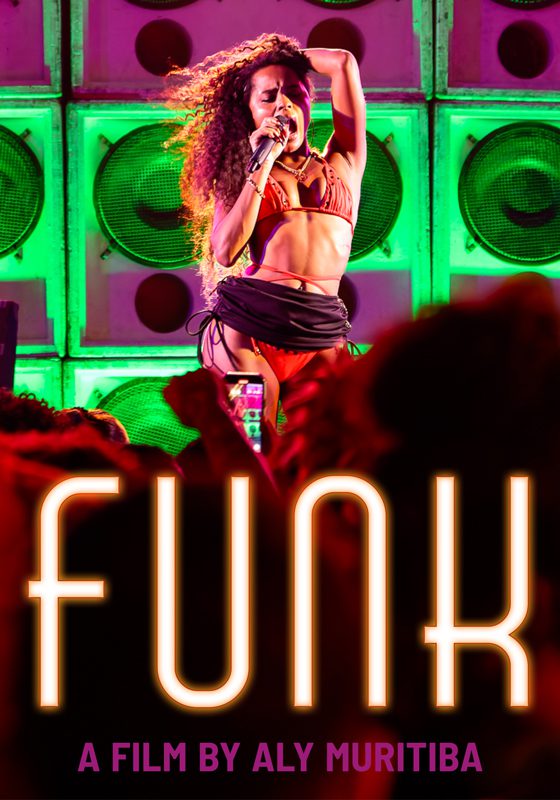
E se manifesta ainda na forma como Sabrina é enquadrada. A protagonista interpretada com um enorme carisma e presença de cena por Duda Santos é enquadrada, em muitos momentos, de baixo para cima com a câmera explorando e passeando por seu corpo. MC Sabrina torna-se um objeto de contemplação visual. Em um baile funk, isso é autonomia. Mas no cinema, isso pode ser apenas olhar exploratório. Enquanto artista do funk, a mulher pode utilizar o próprio corpo como instrumento de expressão artística. Mas enquanto objeto do olhar do artista e homem, a pergunta faço é: qual o limite que separa a câmera como partícipe dessa autonomia feminina e como instrumento de espetáculo para o prazer visual?
Aqui, um parêntese: não tenho dúvida que Aly tenha desejado celebrar, visualmente, a mesma autonomia e liberdade que Sabrina expõe no palco. Mesmo assim, a sensação que senti me aproximou mais da exploração, não da emancipação. Não se trata de acusação moral e nem de questionamento da intenção de Aly ou dos corroteristas (Fernando Barcellos, Leandro Saraiva e Taísa Machado), mas de perceber como as imagens produzem sentidos independente de intenções. Sob o pretexto de exaltar uma personagem que luta para controlar sua própria imagem e sua própria carreira, o filme termina reproduzindo os mesmos mecanismos que a transformam novamente num objeto.
Esse problema torna-se ainda mais evidente porque o roteiro aposta em uma estrutura dramática excessivamente esquemática e clichê. As relações que deveriam robustecer emocionalmente a trajetória de Sabrina raramente ultrapassam o estereótipo. A exceção é a sua relação com a mãe, MC Priscilla (MC Nem), uma veterana da cena funk que funciona simultaneamente como alerta e espelho do futuro possível. E mesmo que haja um sem número de viradas no rotorno previsíveis, é o momento em que o filme mais consegue sustentar a ideia de uma personagem, e não de um objeto fílmico. O mesmo não acontece com a melhor amiga Raíssa (Lellê), também sua empresária improvisada, com quem briga e depois reata como se nada houvesse acontecido ou com os diversos personagens que orbitam sua ascensão artística, a exemplo de DJ Fabrício (Crazy Jeff), que deserta Sabrina para depois reaparecer, ou do empresário Alberto (Cláudio Gabriel).
Não ajuda o fato de que todos os conflitos surjam e se resolvam de maneira mecânica. Os encontros com a polícia, as negociações com o chefão da comunidade (que é seu irmão), os embates com o empresário que deseja torná-la palatável na cena pop e até mesmo o retorno às origens seguem um desenho narrativo tão convencional, que frequentemente lembram versões de histórias que o cinema contou tanto e de formas melhoras. A jornada da artista, alvo de um ataque racista, descoberta na favela, transformada em fenômeno e posteriormente reconectada às raízes surge como uma sucessão de etapas obrigatórias: a explosão para a fama, a personalidade sob controle, a riqueza e a fama acompanhadas da perda da identidade, e a reconstrução das pontes que havia queimada atrás de si.
Nesse contexto, as canções acabam se tornando o principal elemento de vitalidade do filme. As performances intensas conferem energia à energia, auxiliadas pela força que Duda traz à personagem, tanto nos palcos, quanto fora deles. A decepção é até maior por causa disso. O talento da atriz e a cena funk certamente mereciam um filme melhor. Até porque, por mais que seja um filme produzido na comunidade – os créditos revelam isso, não sei se o filme observa a comunidade de dentro para fora ou de fora para dentro. Se torna MC Sabrina mais um estudo de caso cinematográfico sobre aqueles artistas ditos difíceis e problemáticos (leia-se: cientes do que querem) que ascendem à fama negociando suas raízes, ou se a enxerga como uma mulher entre mundos, em um estágio de amadurecimento.
Seja como for, o filme não pode fugir de relações humanas simplificadas e maniqueístas, nem em um roteiro esquemático e convencional, que na intenção de celebrar uma cultura historicamente marginalizada, termina por reproduzir um olhar que certamente reprovaria.
Funk está na seleção do Festival de Tribeca, na seção International Narrative Competition.
English review
Aly Muritiba is a filmmaker whose career I have followed virtually since the beginning of my own professional journey as a film critic. After the short films that first established his reputation within Brazilian cinema (Courtyard and The Factory), I remember Aly premiering the documentary A Gente at a film festival in my hometown. Then came the trilogy formed by To My Beloved Dead, Private Desert, and Barba Ensopada de Sangue, which, to me, reveals what ultimately drives his cinema: an investigation of displaced characters, often men in crisis, moving through physical and emotional spaces while attempting to fill absences and voids they themselves are unable to name. Taciturn, introspective men who carry within them the burden of opportunities never lived.
For that reason, I had been eagerly awaiting the premiere of Funk at the Tribeca Festival. Not merely because it represents Brazil in an international competitive section, nor because it explores a musical genre that recent Brazilian fiction cinema has seldom embraced, but because it offered the possibility of seeing Muritiba tackle a narrative centered on a female protagonist emerging from a historically marginalized environment: Rio de Janeiro’s favelas. The result, however, is profoundly disappointing—not only because the film fails to fulfill its dramatic ambitions, but because it ends up exposing larger issues (the male gaze, the ethnographic gaze upon the favela) that stronger works usually absorb into their organic structure, whereas here they emerge as open fractures.
The first issue concerns the perspective through which the film approaches the world it portrays: Rio’s funk parties. Although Muritiba clearly approaches the material with noble intentions, those intentions rarely translate into anything beyond a conventional film at best, and a problematic one at worst. The Morro dos Prazeres community is depicted like virtually every other favela previously portrayed in Brazilian cinema, not through its own dynamics or contradictions. The face of the hill is the same. Its problems are the same: the drug lord or the police. Its dreams are the same, visualized through what MC Sabrina can glimpse from her balcony—the heart of Rio de Janeiro appearing almost unattainable.
Likewise, funk itself is approached in an incomplete manner, treated solely as a musical genre when, as a cultural phenomenon, it is far more complex. Despite my own reservations about funk, it is undeniable that it constitutes a space of resistance against the criminalization of poverty and social exclusion and, in many instances, functions as a movement through which women—often Black or mixed-race women—reclaim ownership of their own bodies, asserting the right to perform their sexuality and desire according to their own rules. In other words, against the status quo. None of this is necessarily absent from the context surrounding Funk. The problem is that much of it must be supplied by the viewer. A spectator capable of seeing only “promiscuity” is unlikely to perceive the provocation embedded in the lyrics of the self-possessed MC Sabrina.
This gap inevitably recalls the debates that have accompanied the critical reception of City of God over the years. Not because the films resemble one another beyond sharing the setting of Rio’s hillsides, but because both provoke the same question: where does the gaze originate? Along with it come the familiar consequences of ethnographic cinema when it regards the Other as something strange and exotic—a concern made even more troubling within the context of an international film festival. Evidently, one does not need to belong to a community in order to portray it. Film history is filled with examples that dismantle such a narrow and reductionist notion. Yet the strongest films either eliminate this element or conceal it through narrative, formal, and aesthetic strategies, as well as through empathy. In Funk, it remains fully exposed.
It is also evident in the way Sabrina is framed. The protagonist, played with remarkable charisma and screen presence by Duda Santos, is repeatedly filmed from low angles while the camera lingers upon and traverses her body. MC Sabrina becomes an object of visual contemplation. At a funk party, that may signify autonomy. In cinema, however, it may simply become an exploratory gaze. As a funk artist, a woman may employ her own body as a tool of artistic expression. But as the object of an artist’s—and a man’s—gaze, the question becomes: where exactly is the boundary separating the camera as a participant in female autonomy from the camera as an instrument of visual spectacle?
A brief parenthesis here: I have no doubt that Muritiba intended to celebrate, visually, the same autonomy and freedom Sabrina displays on stage. Even so, the sensation I experienced leaned far closer to exploitation than emancipation. This is neither a moral accusation nor a challenge to the intentions of Muritiba or his co-writers (Fernando Barcellos, Leandro Saraiva, and Taísa Machado), but rather an acknowledgment that images generate meanings independently of intentions. Under the pretense of exalting a character struggling to control her own image and career, the film ultimately reproduces the very mechanisms that once again transform her into an object.
The problem becomes even more evident because the screenplay relies on an excessively schematic and clichéd dramatic structure. The relationships that should emotionally enrich Sabrina’s journey rarely move beyond stereotype. The exception is her relationship with her mother, MC Priscilla (MC Nem), a veteran of the funk scene who functions simultaneously as a warning and as a reflection of a possible future. Even though the script is filled with predictable turns, this is where the film comes closest to sustaining the idea of a character rather than a cinematic object. The same cannot be said of her best friend Raíssa (Lellê), who also serves as her improvised manager and with whom she quarrels and reconciles as though nothing had happened, or the various characters orbiting her rise to fame, such as DJ Fabrício (Crazy Jeff), who abandons Sabrina only to reappear later, or the manager Alberto (Cláudio Gabriel).
It does not help that every conflict emerges and resolves itself mechanically. Encounters with the police, negotiations with the community’s crime boss (who also happens to be her brother), confrontations with the manager eager to make her more palatable to the pop market, and even her eventual return to her roots all follow such a conventional narrative blueprint that they frequently resemble inferior versions of stories cinema has already told—and told better. The trajectory of an artist who suffers a racist attack, is discovered in the favela, becomes a phenomenon, and eventually reconnects with her origins unfolds as a succession of mandatory checkpoints: the explosion into fame, the managed public persona, wealth and celebrity accompanied by the loss of identity, and finally the rebuilding of bridges she herself had burned.
Within this context, the songs become the film’s primary source of vitality. The performances possess genuine intensity and inject the narrative with energy, aided considerably by the force Duda Santos brings to the role both onstage and off. The disappointment is greater precisely because of this. The actress’s talent and the funk scene itself deserved a better film. After all, while Funk may have been produced within the community—the credits certainly indicate as much—I remain uncertain whether it observes that community from the inside out or from the outside in. Whether it sees MC Sabrina as yet another cinematic case study of those supposedly difficult and problematic artists (read: artists who know exactly what they want) who negotiate their roots while ascending to fame, or as a woman caught between worlds in the midst of a process of maturation.
Be that as it may, the film cannot escape its simplified and often manichaean human relationships, nor its schematic and conventional screenplay, which, in attempting to celebrate a historically marginalized culture, ultimately reproduces a gaze that it would almost certainly condemn.
Funk had its world premiere at Tribeca Film Festival, at International Narrative Competition.

Crítico de cinema filiado a Critics Choice Association, à Associação Brasileira de Críticos de Cinema, a Online Film Critics Society e a Fipresci. Atuou no júri da 39ª Mostra Internacional de Cinema em São Paulo/SP, do 12º Fest Aruana em João Pessoa/PB, do 24º Tallinn Black Nights Film na Estônia, do 47º TIFF – Festival Internacional de Cinema em Toronto. Ministrante do Laboratório de Crítica Cinematográfica na 1ª Mostra Internacional de Cinema em São Luís (MA) e Professor Convidado do Curso Técnico em Cinema do Instituto Estadual do Maranhão (IEMA), na disciplina Crítica Cinematográfica. Concluiu o curso de Filmmaking da New York Film Academy, no Rio de Janeiro (RJ) em 2013. Participou como co-autor dos livros 100 melhores filmes brasileiros (Letramento, 2016), Documentário brasileiro: 100 filmes essenciais (Letramento, 2017) e Animação Brasileira – 100 Filmes Essenciais (Letramento, 2018). Criou o Cinema com Crítica em fevereiro de 2010 e o Clube do Crítico em junho de 2020.